
Why Should CXOs Simplify Reward Ecosystems Through Platform Consolidation?

Sign up for our newsletter for trending top content!
Introduction
Many organisations operate separate platforms for employee recognition, customer loyalty, channel incentives, and reward fulfilment. While each system may solve a specific business problem, together they often create duplicated costs, fragmented reporting, inconsistent user experiences, and operational complexity. According to McKinsey, organisations that simplify technology ecosystems and improve digital integration are better positioned to accelerate growth and improve operational performance. For CXOs, reward platform consolidation has therefore become a strategic transformation initiative rather than an IT optimisation exercise.
This guide explains why fragmented reward ecosystems reduce enterprise efficiency, how a unified rewards platform improves governance and business performance, which evaluation framework supports platform consolidation, and how integrated reward experiences benefit employees, customers, and channel partners alike.
Why Are Fragmented Reward Ecosystems Limiting Enterprise Growth?
Many enterprises have accumulated separate solutions over time as different business functions introduced programmes to address specific objectives. Human Resources manages employee recognition. Marketing operates customer loyalty initiatives. Sales manages channel incentives. Procurement sources rewards independently. Finance monitors separate budgets. Each function may succeed individually, but the organisation often loses visibility across the broader rewards ecosystem.
According to Deloitte, organisations that align technology, operations, and customer experience create stronger enterprise performance because they reduce unnecessary complexity and improve decision-making. Fragmented reward platforms make this alignment more difficult by introducing duplicated administration, inconsistent governance, and disconnected reporting.
Common enterprise challenges include:
- Multiple reward catalogues.
- Separate supplier relationships.
- Inconsistent user experiences.
- Duplicate technology investments.
- Disconnected analytics.
- Manual reconciliation processes.
- Limited enterprise visibility.
Instead of managing separate systems, CXOs increasingly seek unified platforms that support multiple business functions while maintaining consistent governance and operational efficiency.
Platform consolidation enables leadership teams to manage rewards strategically rather than department by department.
What Are the Business Benefits of Consolidating Employee, Consumer and Channel Rewards?
Reward consolidation creates value far beyond technology simplification. A unified platform supports a consistent engagement strategy across employees, customers, distributors, resellers, and channel partners while reducing operational overhead.
A consolidated ecosystem can support:
According to Bain & Company, organisations strengthen long-term relationships when they consistently reward behaviours that create value. A unified rewards ecosystem allows enterprises to apply this principle across every stakeholder group instead of managing disconnected engagement strategies.
Consolidation also improves purchasing efficiency. A shared reward catalogue supports multiple programmes while reducing supplier management, fulfilment complexity, and procurement effort. Employees, customers, and partners benefit from broader redemption choice, while the organisation gains better governance and stronger commercial leverage.
How Should CXOs Evaluate a Unified Rewards Platform?
Selecting a unified rewards platform requires a broader perspective than evaluating individual recognition or loyalty solutions. CXOs should assess whether the platform can support multiple business functions through one scalable architecture.
A practical evaluation framework includes:
According to Forrester, organisations increasingly prioritise platforms that improve operational efficiency while enabling better customer and employee experiences. This makes consolidation an executive decision rather than a departmental technology purchase.
A successful evaluation should consider total cost of ownership alongside strategic value. Organisations should compare administration effort, supplier management, reporting capability, implementation complexity, and long-term scalability rather than software features alone.
The strongest enterprise platforms simplify operations while enabling every business function to deliver more engaging reward experiences.
How Does a Unified Reward Ecosystem Improve Enterprise Efficiency?
A unified reward ecosystem removes operational silos by bringing employee recognition, consumer loyalty, channel incentives, and reward fulfilment onto one platform. Instead of maintaining separate technologies, supplier contracts, reporting systems, and governance processes, organisations manage engagement through a single operating model.
According to McKinsey, organisations that simplify technology landscapes improve operational agility and reduce unnecessary complexity. The same principle applies to enterprise rewards. Consolidation enables business functions to share infrastructure while maintaining programme-specific rules and objectives.
A unified platform delivers measurable operational benefits:
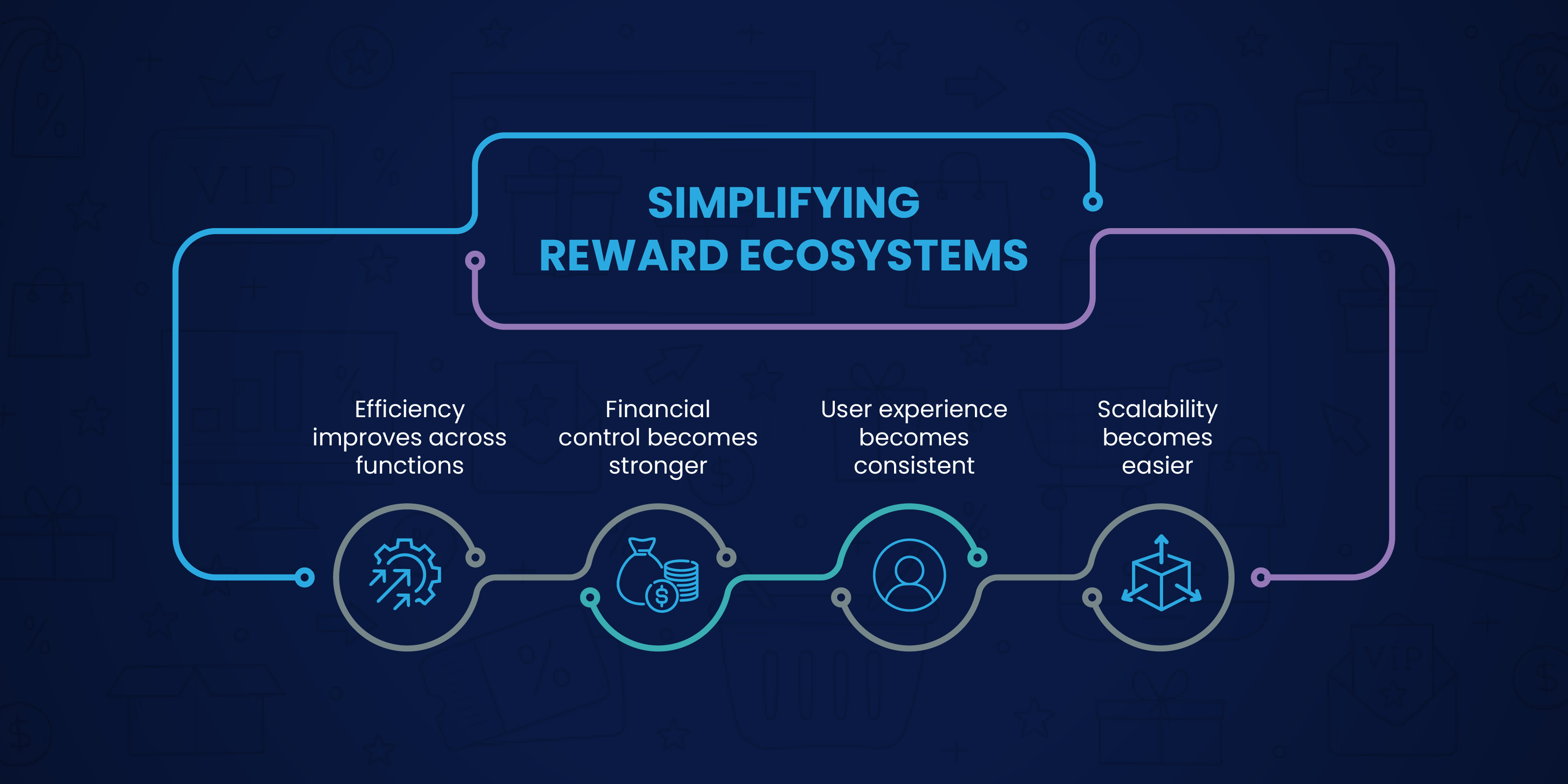
The result is improved governance, lower administrative effort, stronger reporting, and greater consistency across every stakeholder programme. Rather than treating rewards as separate initiatives, organisations can manage them as part of a single enterprise engagement strategy.
What Framework Should CXOs Use When Consolidating Reward Platforms?
Successful platform consolidation begins with business strategy rather than technology selection. CXOs should define the enterprise outcomes they want to achieve before comparing vendors or migration plans.
A practical decision framework includes five stages:
According to Deloitte, organisations that connect technology investments to measurable business outcomes achieve stronger transformation results. Reward consolidation should therefore focus on improving governance, employee engagement, customer loyalty, partner performance, and operational efficiency simultaneously.
Executive teams should also consider future scalability. The chosen platform should accommodate additional business units, new geographies, evolving reward categories, and changing engagement strategies without requiring multiple technology investments.
How Can The Reward Store Support Enterprise Reward Consolidation?
The Reward Store has been designed to help organisations consolidate employee recognition, customer loyalty, and channel incentive programmes within one connected rewards ecosystem.
Its three core solutions address different engagement objectives while sharing a common reward infrastructure:
All three connect to an integrated reward marketplace offering gift cards from more than 5,000 brands, hotel bookings, flight bookings, dining vouchers, sports experiences, golf experiences, merchandise, bus bookings, concierge services, and curated experiences.
This shared ecosystem allows organisations to standardise fulfilment, simplify supplier management, improve reporting, and deliver consistent reward experiences across employees, customers, distributors, dealers, resellers, and partners.
Rather than investing in multiple disconnected systems, CXOs can align engagement strategies under one enterprise platform while allowing each business function to maintain programme-specific rules and objectives.
Frequently Asked Questions
What is a unified reward ecosystem?
A unified reward ecosystem brings employee recognition, customer loyalty, channel incentives, and reward fulfilment together within one platform. It replaces fragmented technologies with a shared infrastructure that supports multiple business functions while improving governance and operational efficiency.
How does platform consolidation reduce enterprise costs?
Platform consolidation reduces duplicate software, supplier management, administration, reporting, and fulfilment processes. It also enables organisations to negotiate more efficiently with reward suppliers while improving technology utilisation across departments.
Why should organisations consolidate employee, consumer, and channel rewards?
Although each audience has different engagement objectives, they all require reward management, fulfilment, reporting, analytics, and governance. Consolidating these capabilities improves consistency while reducing operational complexity.
Can The Reward Store support enterprise-wide reward consolidation?
Yes. The Reward Store combines ApplaudIQ, Rekyndl, and Paytives within a connected rewards ecosystem, allowing organisations to manage employee recognition, customer loyalty, and channel incentives through one integrated platform.
When should a business consider consolidating reward platforms?
Platform consolidation is most valuable when organisations operate multiple engagement programmes, experience duplicated administration, manage several reward suppliers, or require executive-level reporting across employee, customer, and partner initiatives.
Conclusion
Reward platform consolidation has become a strategic business decision rather than a technology upgrade. By bringing employee recognition, consumer loyalty, channel incentives, and reward fulfilment together, organisations simplify operations while improving governance, reporting, and engagement outcomes.
CXOs who invest in a unified reward ecosystem position their organisations to reduce complexity, improve efficiency, and deliver consistent experiences across every stakeholder group. As enterprise engagement strategies continue to evolve, integrated reward platforms will become an increasingly important source of competitive advantage.
Discover how ApplaudIQ, together with Rekyndl and Paytives, helps organisations consolidate employee, customer, and channel rewards through one connected enterprise rewards ecosystem.
Sign up for our newsletter for trending top content!


