
How Can HR Leaders Maintain Recognition Value Through Structured Governance?

Sign up for our newsletter for trending top content!
Introduction
Recognition programmes lose impact when employees perceive them as inconsistent, subjective, or poorly managed. According to Gallup, employees who receive meaningful recognition are more engaged, more productive, and less likely to leave their organisation. However, recognition only delivers lasting value when organisations apply consistent standards, transparent processes, and measurable governance across the entire programme.
This guide explains why structured governance strengthens employee recognition, which governance practices help organisations maintain programme credibility, how HR Leaders can scale recognition consistently across distributed workforces, and why technology is essential for managing recognition programmes effectively.
Why Does Recognition Governance Matter?
Recognition should reinforce organisational values, encourage positive behaviours, and create a consistent employee experience. Without governance, programmes often become inconsistent across departments, managers, and locations, reducing employee trust and participation.
According to O.C. Tanner's Global Culture Report, employees place greater value on recognition when it is authentic, timely, and fairly distributed. Governance helps organisations achieve these outcomes by establishing clear programme rules, approval processes, and recognition standards.
Poor governance commonly results in:
- Inconsistent recognition practices.
- Unequal participation across teams.
- Recognition bias.
- Budget overspend.
- Duplicate awards.
- Reduced employee confidence.
HR Leaders should therefore treat recognition governance as an essential component of employee experience rather than an administrative process. Clear policies help managers recognise employees consistently while ensuring recognition remains aligned with organisational culture and business objectives.
What Governance Structures Maintain Recognition Value?
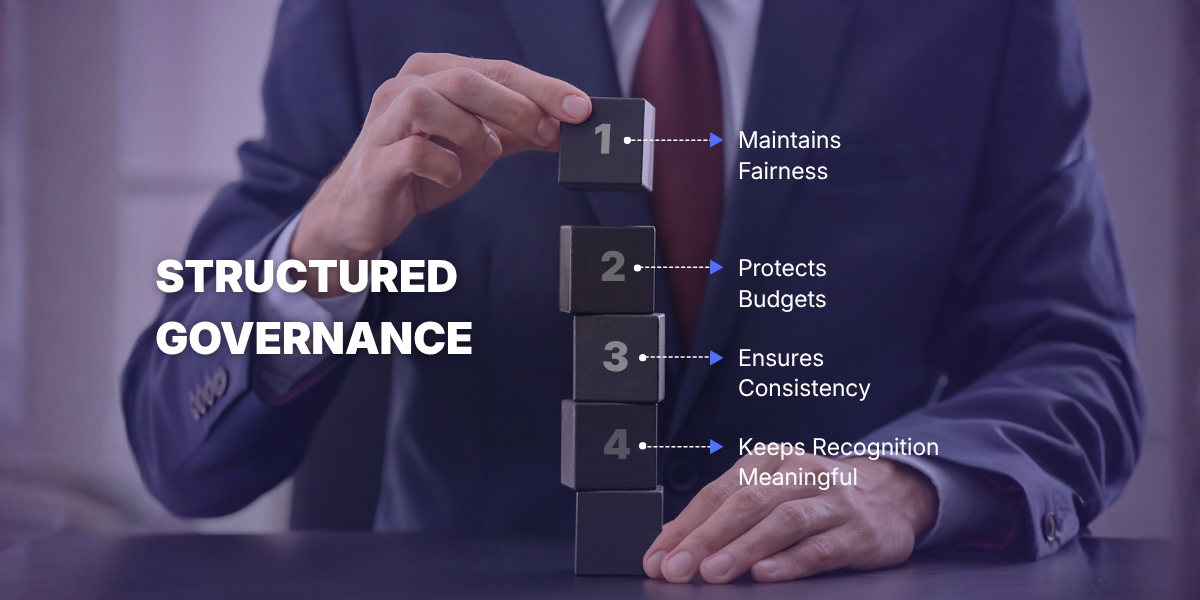
Strong governance combines policy, accountability, technology, and measurement. HR Leaders should define how recognition is awarded, who approves rewards, how budgets are managed, and how programme performance is monitored.
A practical governance framework includes:
According to SHRM, recognition programmes become more effective when leaders consistently reinforce desired behaviours rather than relying on informal appreciation alone. Structured governance provides the foundation for that consistency.
Governance should also include clear communication so employees understand how recognition works, what behaviours are rewarded, and how achievements are evaluated.
How Should HR Leaders Build Recognition Governance at Scale?
As organisations grow, recognition programmes must support multiple business units, locations, and management teams while maintaining a consistent employee experience.
A scalable governance model includes:
According to Mercer, organisations that standardise employee experience across locations strengthen organisational culture while improving engagement. Recognition governance contributes directly to this objective by ensuring employees receive consistent recognition regardless of department or geography.
HR Leaders should also review recognition analytics alongside engagement surveys, retention data, and manager performance. This broader perspective enables continuous improvement while helping organisations identify areas where recognition practices require additional support or coaching.
Well-governed recognition programmes remain credible because employees trust both the process and the outcomes. That trust ultimately strengthens participation, reinforces organisational values, and improves the overall employee experience.
How Does ApplaudIQ Support Recognition Governance?
Managing recognition across a growing organisation requires more than good intentions. HR teams need centralised administration, approval controls, reporting, and analytics to ensure every recognition programme remains fair, transparent, and aligned with organisational objectives.
According to Deloitte, organisations that apply structured governance to people programmes improve consistency while reducing administrative complexity. Recognition platforms extend this approach by automating workflows and providing visibility into programme performance.
An effective recognition platform should provide:
ApplaudIQ combines employee recognition with governance tools that help HR teams standardise programme administration across multiple business units and locations. Administrators can monitor participation, review recognition activity, manage approval workflows, and evaluate programme performance through centralised dashboards.
This combination of automation and oversight enables organisations to maintain recognition quality while scaling employee engagement initiatives efficiently.
What Framework Should HR Leaders Use to Measure Governance Success?
Recognition governance should be evaluated through measurable business outcomes rather than policy compliance alone. HR Leaders should monitor whether governance improves programme adoption, fairness, engagement, and organisational culture.
A balanced governance scorecard includes:
According to Gallup, consistent recognition contributes to stronger employee engagement because employees perceive appreciation as genuine and equitable. Governance analytics help HR teams identify areas requiring intervention before participation declines.
Programme reviews should also include qualitative feedback from employees and managers to ensure governance processes remain supportive rather than restrictive.
How Can Governance Prevent Recognition Fatigue?
Recognition loses value when awards become routine, repetitive, or disconnected from meaningful achievements. Structured governance helps prevent recognition fatigue by ensuring appreciation remains timely, relevant, and linked to behaviours that support organisational success.
According to O.C. Tanner, recognition creates the greatest impact when it feels authentic and specific rather than automatic or transactional. Governance supports this by encouraging quality recognition instead of simply increasing recognition volume.
HR Leaders can reduce recognition fatigue by:
- Defining clear recognition criteria.
- Encouraging meaningful recognition messages.
- Balancing peer and manager recognition.
- Refreshing campaigns throughout the year.
- Reviewing participation trends regularly.
- Updating reward options based on employee preferences.
Governance also ensures that recognition evolves with organisational priorities. As workforce expectations change, HR teams can refine programme rules, introduce new recognition categories, and improve communication without compromising fairness or consistency.
Frequently Asked Questions
How can organisations maintain recognition programme consistency at scale?
Consistency requires clear policies, standardised approval workflows, manager training, budget governance, and continuous reporting. Technology also helps by automating processes and providing visibility across departments and locations.
What governance structures prevent recognition fatigue?
Recognition fatigue can be reduced through structured eligibility rules, meaningful recognition criteria, balanced reward frequency, regular programme reviews, and ongoing analytics. Governance ensures recognition remains relevant rather than repetitive.
Why is governance important in employee recognition?
Governance creates fairness, transparency, and consistency across recognition programmes. Employees are more likely to value recognition when they understand how achievements are evaluated and trust the programme's integrity.
Can ApplaudIQ support recognition governance?
Yes. ApplaudIQ provides administration tools, approval workflows, role-based permissions, analytics dashboards, budget tracking, and reporting capabilities that help organisations manage employee recognition consistently at scale.
When should HR Leaders review recognition governance?
HR teams should review governance metrics monthly, analyse programme performance quarterly, and conduct a comprehensive annual evaluation. Regular reviews ensure recognition remains aligned with organisational objectives and employee expectations.
Conclusion
Structured governance protects the long-term value of employee recognition by ensuring programmes remain fair, consistent, and meaningful as organisations grow. By combining clear policies with technology, analytics, and continuous optimisation, HR Leaders can strengthen employee trust while improving engagement and organisational culture.
As recognition programmes become increasingly strategic, governance will remain essential for maintaining credibility, encouraging participation, and delivering measurable business outcomes.
Discover how ApplaudIQ helps HR teams manage employee recognition through centralised administration, approval workflows, governance controls, analytics dashboards, and automated programme management.
Sign up for our newsletter for trending top content!


