
Why Some Incentive Programmes Only Reward Top Performers and Why That Is Risky

Sign up for our newsletter for trending top content!
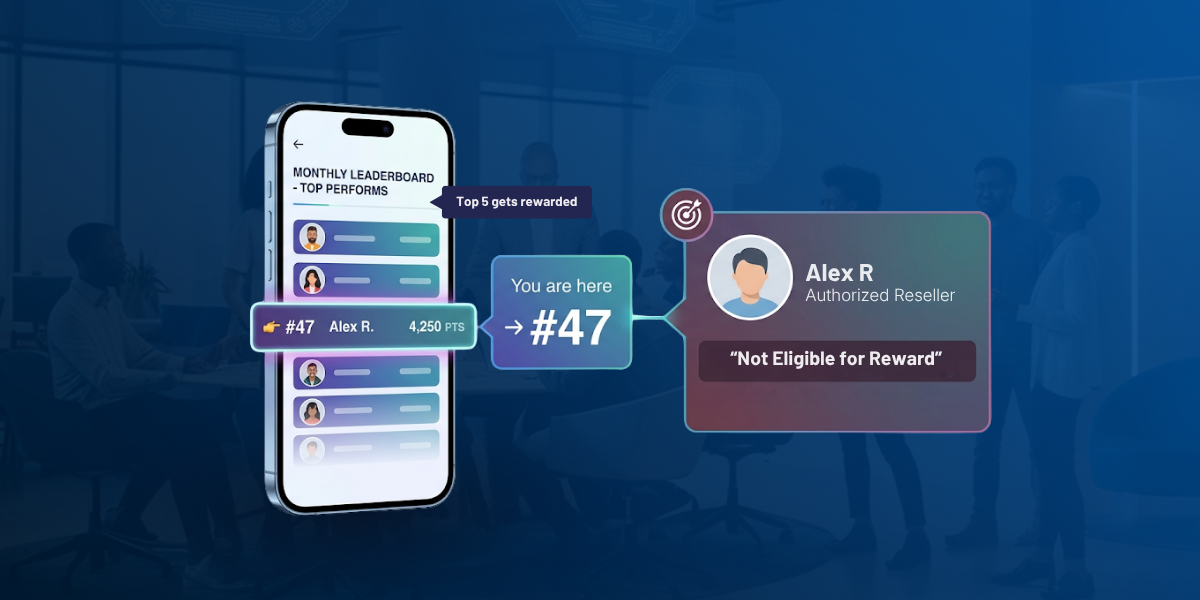
Incentive programmes can increase performance by an average of 22 per cent, according to research reviewed by the Incentive Research Foundation. Yet the same research warns that results depend heavily on programme design. A sales contest that rewards only one winner, or a small group at the top of a leaderboard, may generate an immediate performance spike. It can also convince most participants that further effort will not change the outcome.
For Sales Leaders, this creates a material commercial risk. The programme may reward established high performers without improving the productivity of the wider sales force or partner network.
This article explains why organisations adopt winner takes all incentive programmes, how these structures affect different performance groups, and how tiered incentive design can increase participation without weakening standards.
Why Do Sales Leaders Choose Winner Takes All Incentive Programmes?
Winner takes all incentive programmes appear efficient because they concentrate the reward budget on the people who produce the highest results. They are also easy to explain: finish first, enter the top five, or exceed every other participant to earn the reward.
This simplicity can make the structure attractive when Sales Leaders need to launch a short campaign quickly. A narrow winner pool also creates visible competition and gives senior management a clear success story to communicate.
However, the model assumes that every participant sees the top position as attainable. That assumption rarely holds across sales teams with different territories, account portfolios, market maturity, experience levels, or partner capabilities.
McKinsey recommends role-specific sales incentives because different commercial roles influence revenue in different ways. It also advises organisations to reward interim progress during long sales cycles rather than relying entirely on the final transaction. A single leaderboard often ignores both principles.
The Incentive Research Foundation makes a similar distinction. It defines an incentive as something offered in advance to encourage a specific behaviour or outcome. A programme should therefore motivate additional effort, not merely compensate participants who would probably have led the rankings without it.
A winner takes all structure may still suit a short, optional contest among closely matched participants. It becomes risky when organisations use it as the main mechanism for improving broad sales performance.
Why Does Rewarding Only Top Performers Reduce Wider Participation?
Participants assess an incentive programme by asking two practical questions: “Can I earn something?” and “Will additional effort improve my position?” When the answer to either question becomes no, motivation weakens.
Research reviewed by the Incentive Research Foundation found that reward programmes produced an average performance gain of 22 per cent compared with no reward programme. Programmes lasting longer than six months generated average gains of 44 per cent for individual rewards and 48 per cent for team rewards. These findings support the value of incentives, but they also demonstrate the importance of sustained participation.
A narrow winner pool undermines that participation in three ways.
Mid Performers Stop Pursuing Incremental Gains
Mid performers often represent the largest available source of additional revenue. They may not become the highest-ranked sellers during one campaign, but many can improve conversion rates, increase product mix, reactivate accounts, or close more opportunities.
If only the top few positions earn rewards, these participants may decide that extra effort has little expected value
New and Developing Participants Face a Structural Disadvantage
New sales representatives and recently enrolled partners usually begin with smaller pipelines, less product knowledge, or fewer established accounts. Ranking them against mature participants can turn the incentive into a measure of starting position rather than improvement.
Fixed Rankings Can Make the Result Predictable
Once the same participants repeatedly occupy the top positions, the programme stops functioning as a motivational mechanism. It becomes an additional payment for an existing performance hierarchy.
Sales Leaders can reduce this risk by rewarding achievement against clear thresholds, personal improvement, strategic behaviours, and team outcomes alongside absolute sales volume.
How Does Winner Takes All Design Affect Different Sales Performance Groups?
A strong incentive programme should create productive movement across the performance distribution. Winner takes all programmes often focus too much attention on the smallest group.
McKinsey advises Sales Leaders to use split incentives where several roles contribute to a sale. Clear allocation rules can encourage collaboration and reduce disputes over who receives credit. A winner takes all programme can do the opposite by encouraging participants to protect leads, resist joint selling, or focus only on activity that improves their individual ranking.
Gallup also reports that only 22 per cent of employees believe they receive the right amount of recognition for their work. Employees receiving high-quality recognition were 45 per cent less likely to have left their organisation two years later. Although sales incentives and employee recognition serve different purposes, both findings show the risk of making acknowledgement too scarce.
Sales Leaders should not lower performance expectations. They should create more than one credible route to achievement.
What Percentage of Participants Should Earn Rewards in an Incentive Programme?
There is no universal percentage that applies to every sales or channel incentive programme. The appropriate earning rate depends on the programme objective, participant capability, campaign duration, reward budget, and difficulty of the target.
A practical design principle is to ensure that every eligible participant can identify an attainable first threshold. This does not mean that everyone should receive the same reward or that participation alone should trigger a payout. It means that the programme should offer credible earning opportunities across multiple performance levels.
For many sales improvement programmes, leaders can begin by modelling reward attainment across three groups:
- Entry tier: Rewards participants who complete a strategically useful action or reach an initial threshold.
- Growth tier: Rewards meaningful improvement, consistent achievement, or progress beyond the standard target.
- Elite tier: Provides higher-value rewards for exceptional results, stretch performance, or strategic revenue contribution.
Sales Leaders should test the proposed tiers against historical data before launch. If modelling shows that fewer than 10 per cent of capable participants can earn any reward, the programme may operate more like a competition than a broad performance incentive. If nearly everyone qualifies without changing behaviour, the threshold may be too low.
The correct measure is not simply the number of winners. It is the amount of profitable, incremental behaviour the programme creates for every unit of reward expenditure.
How Can Sales Leaders Avoid Winner Takes All Programme Design?
Sales Leaders can replace winner takes all structures with a tiered framework that protects ambition while widening participation.
1. Define the Behaviour Before Selecting the Reward
The Incentive Research Foundation advises organisations to evaluate both financial outcomes and less visible programme effects, including engagement, morale, customer satisfaction, and organisational behaviour. Start with the commercial change required, such as higher revenue, better margin, new product adoption, faster claims submission, or improved partner activation.
The Reward Store’s guide to goal setting in incentive programmes explains how specific targets reduce ambiguity and align participant effort with business priorities.
2. Segment Participants Before Setting Thresholds
Compare participants with genuinely similar opportunities. Territory potential, role, tenure, partner type, account size, and market maturity can all affect attainable performance.
3. Combine Absolute and Relative Achievement
Use absolute thresholds for core earning opportunities. Add rankings, leaderboards, or elite rewards as a secondary layer. This approach allows more participants to earn while preserving visible recognition for exceptional performance.
4. Reward Progress During Long Sales Cycles
McKinsey recommends staged compensation for extended sales cycles. Sales Leaders can reward qualified opportunities, verified demonstrations, account activation, product certifications, or other milestones before the final sale.
5. Make Rules and Progress Visible
Participants should see the qualifying criteria, their current progress, and the calculation method. The Reward Store’s article on transparency in incentive programmes outlines why clear rules strengthen trust and participation.
6. Automate Tiered Calculations and Payouts
Manual spreadsheets make multi-tier programmes difficult to administer. Paytives enables organisations to configure custom incentive rules, track partner performance, automate calculations, manage approvals, and distribute rewards across global partner networks.
How Should Sales Leaders Choose Between a Contest and a Tiered Incentive Programme?
The correct structure depends on the business objective.
Leaderboards can still support a tiered programme when Sales Leaders use them carefully. They provide visibility, competition, and progress feedback, but should not become the only route to a reward.
The Reward Store’s guide to how leaderboards influence performance explains how rankings can support motivation when programme owners combine them with clear targets and appropriate behavioural measures.
The decision should return to one question: does the structure motivate the next valuable action from a broad group, or does it merely identify who already performs best?
Frequently Asked Questions
What Percentage of Participants Should Earn Rewards in an Incentive Programme?
No fixed percentage suits every programme. Sales Leaders should model likely attainment using historical performance and ensure that capable participants across several performance bands have a credible route to earning. A programme in which very few participants can earn anything should be treated as a sales contest, not a broad incentive programme.
How Can We Avoid Winner Takes All Programme Design?
Use several performance tiers, segment participants by comparable opportunity, and combine absolute thresholds with selective ranking-based rewards. Reward strategic behaviours and measurable improvement as well as final sales results.
Why Are Tiered Incentives More Effective Than a Single Prize?
Tiered incentives maintain a visible connection between additional effort and potential reward. They can motivate mid performers and developing participants while preserving premium rewards for exceptional achievement. Research reviewed by the Incentive Research Foundation shows that programme design strongly influences whether incentives generate sustained performance gains.
When Should a Sales Team Use a Winner Takes All Contest?
Use it for a brief, optional campaign when participants have comparable opportunities and the organisation wants a highly visible competitive event. Avoid using it as the primary incentive structure for diverse territories, long sales cycles, or broad partner ecosystems.
Can Paytives Support Tiered Channel Partner Incentive Programmes?
Yes. Paytives allows Sales Leaders to build custom incentive rules, establish multiple achievement thresholds, track partner performance, automate reward calculations, and manage payouts. It connects participants to The Reward Store’s integrated storefront, which includes gift cards from 5,000+ brands, flight bookings, hotel bookings, dining, golf, sports, experiences, merchandise, bus bookings, and concierge services.
Conclusion
Winner takes all incentive programmes can reward excellence, but they rarely provide the strongest mechanism for improving performance across an entire sales force or partner network. Sales Leaders create greater commercial value when participants can see a credible link between their next action and a meaningful reward. Tiered thresholds, participant segmentation, milestone recognition, and transparent progress tracking preserve ambition while widening productive participation. As sales cycles and partner ecosystems become more complex, incentive design must become more precise, measurable, and adaptable.
Sign up for our newsletter for trending top content!


