
How Two-Wheeler and Three-Wheeler OEMs Can Incentivise Tier 2 and Tier 3 Dealer Networks Effectively

Sign up for our newsletter for trending top content!
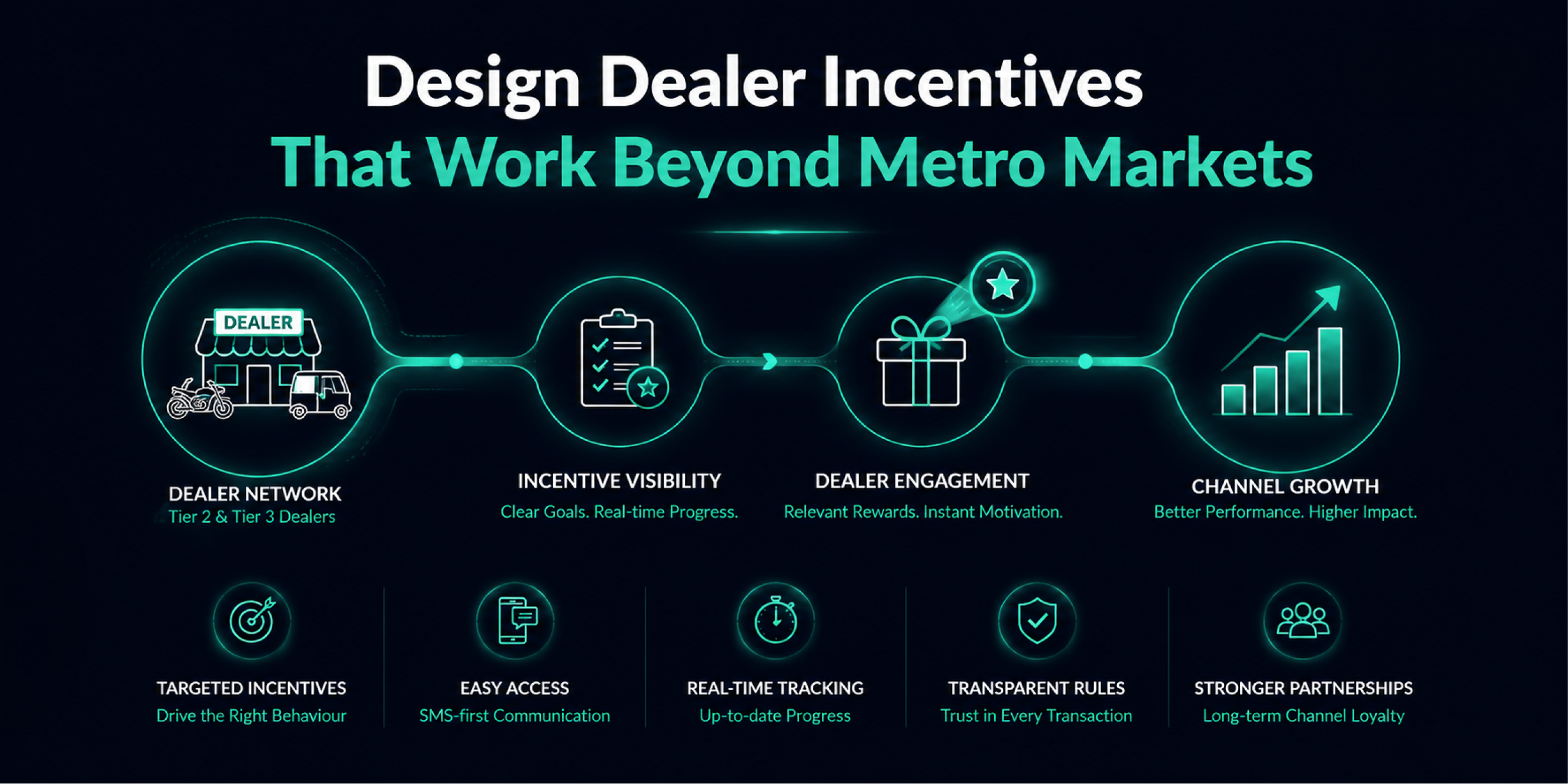
Tier 2 and tier 3 dealer incentive programmes underperform because they are usually the metro programme in a smaller size, rather than a programme designed for how those dealers actually work.
The operating conditions differ in ways that matter to scheme design: thinner margins, less appetite for anything that takes effort to understand, patchy connectivity, and a shop floor where nobody is checking email. A channel partner incentive platform can only reward behaviour it can reach, and reach is the constraint most schemes never address.
The result reads as dealer apathy. It is almost always design.
Why Tier 2 and Tier 3 Dealer Programmes Are Systematically Underdesigned
Most dealer incentive programmes are not built badly. They are built once, for a headquarters view of the network, and then extended outward unchanged.
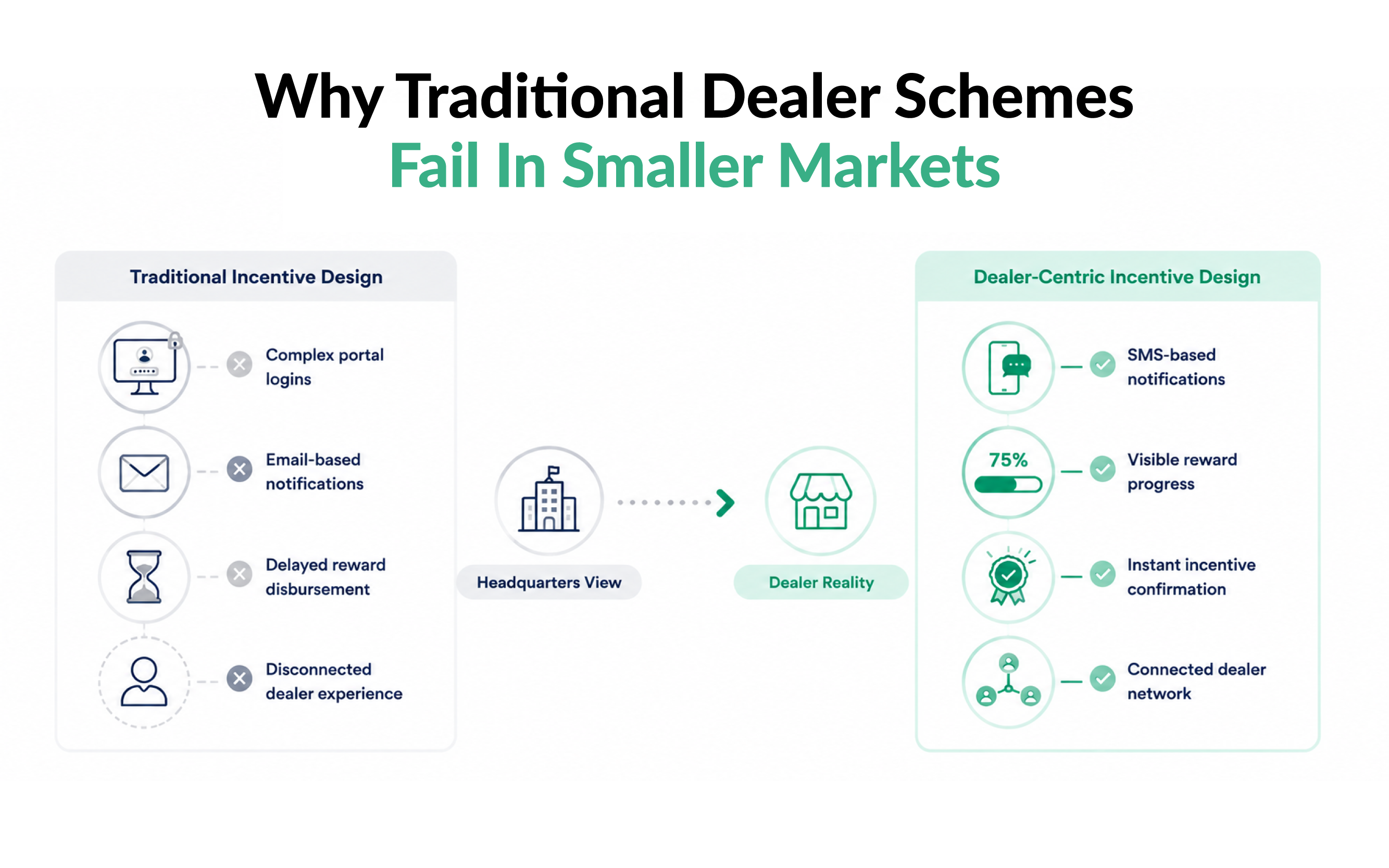
That extension carries assumptions with it. It assumes a dealer principal who will log into a portal to check standing. It assumes email as a working communication channel. It assumes enough margin headroom that a reward arriving at quarter end is worth waiting for. Each assumption holds in a metro dealership and fails somewhere smaller.
There is also a competition for attention that headquarters teams routinely underestimate. A tier 2 dealer is not choosing between your scheme and no scheme. They are holding relationships with more than one manufacturer, at least one financing partner, and usually an insurance tie-up, each with its own programme, its own rules and its own portal. A scheme that is confusing, infrequent or clearly built for somebody else gets deprioritised, and deprioritised is not the same as rejected. Nobody tells you.
The right hand column is a design brief, not a complaint. Every row points at a specific decision.
The Digital Comfort Gap: Access Exists, Confidence Does Not
Connectivity and device ownership in smaller Indian markets have moved faster than comfort with the workflows built on top of them. Those are two different things and programmes conflate them constantly.
A dealership owner in a smaller town may hold a perfectly capable smartphone and still treat a points dashboard as more trouble than it is worth. The obstacles are specific and mundane. A multi-step login is a barrier when the password was set six months ago by somebody who has since left. An app requiring an update is a barrier during a busy sales week. A dashboard that needs interpretation is a barrier when the answer wanted is simply whether the target was hit.
None of this is a literacy problem in the way the phrase is usually meant. It is a friction problem, and friction is cumulative. Each additional step removes a proportion of the network, and the steps compound rather than average.
The design principle that follows is to build for the lowest digital comfort in the network rather than the mean. Minimal steps to earn and to redeem. Balance visible without navigating an application. Communication that never assumes a dealer will proactively check anything.
Why SMS Should Be the Default Channel Rather Than the Fallback
Once digital comfort is accepted as a permanent design constraint rather than a temporary condition, channel choice becomes the highest leverage decision available.
The argument for a text message is structural rather than statistical. It arrives on the device without requiring an application, a login, a current password or a good data connection. It is readable on any handset in the network, including the older ones. It survives a shop floor, where a notification competing with a customer standing in front of you gets dismissed and a text sitting in an inbox does not. And it requires no decision from the dealer to go and look.
An SMS-first approach does not mean abandoning richer channels. It means treating the text message as the default confirmation and nudge layer, with application or web access as an optional deeper view for dealers who want it. A dealer should be able to learn that a target has been reached, that a reward has been credited, or that a new scheme has opened, without opening anything else.
Confirmation speed matters more here than reward size, which is the counterintuitive part. A delayed or ambiguous confirmation damages trust in the programme faster than a delayed reward does, because uncertainty about whether the system is working is worse than knowing a payment is pending.
Micro Incentives at Scale: Low Value, High Frequency Rewards for Small Dealers
Large infrequent rewards suit dealers with the cash flow and the patience to wait for a quarter-end outcome. Many smaller dealers have neither, and a programme built entirely on quarterly milestones loses their attention long before the reward arrives.
The mechanism is worth stating plainly. A reward only shapes behaviour if the dealer can connect the behaviour to it, and that connection weakens with every week of separation. A milestone scheme asks a dealer to hold an abstraction for three months. A micro-incentive closes the loop while the sale is still recent.
Running all three in parallel is what keeps smaller dealers engaged without diluting the larger rewards that metro dealers respond to. Replacing milestones with micro-incentives across the whole network is a common overcorrection and it removes the ambition from the scheme.
When tier differentiation is not the answer
Two situations do not need any of this. Where a network is uniformly digitally fluent, the differentiation adds configuration complexity for no return. And where redemption is low across every tier including metro, the constraint is the reward or the rules rather than the channel, and redesigning communication will not fix it. The diagnostic is to compare redemption rates by tier before committing to a redesign. If they are broadly similar and all low, the problem is elsewhere.
What the Regional Sales Manager Needs to Coach the Programme
A well-designed scheme still depends on somebody coaching dealers to use it, and in most two-wheeler and three-wheeler networks that person is the regional sales manager.
They need two things. The first is visibility: a live view of which dealers in the territory are on track, lagging, or close to a threshold, so the coaching conversation can be specific.
"You are two units from the next band" changes behaviour. "Do make use of the scheme" does not. The second is simplicity: something that can be pulled up during a visit, not a report requiring an analysis step before it becomes useful.
Paytives is a channel partner incentive platform from The Reward Store, and connects incentive logic to real time sales data rather than to periodic manual claims, which is what allows a manager and a dealer to work from the same standing at the same moment.
Without shared visibility, the manager coaches from memory and the dealer guesses at their own progress. Neither produces the consistent behaviour the scheme was built to reward, and the programme gets blamed for a communication failure.
Measuring Dealer Incentive Return Where Point of Sale Data Is Incomplete
Metro and tier 1 networks increasingly report clean, near real-time point of sale data. Smaller dealerships frequently do not, whether through manual billing, inconsistent dealer management system adoption, or straightforward underreporting. For a sales leader asked to demonstrate return, this is a genuine measurement gap rather than an excuse.
The workaround is to measure the upstream behaviours the programme can observe directly. Scheme enrolment. Training completion. Redemption rate. Deal or serial registration where it applies. Engagement with programme communication. These move before the sales figure does and they are available while the point of sale reconciliation is still catching up.
The honest caveat is that these are proxies, and a sales leader should present them as proxies. They indicate whether the programme is being used, which is a necessary condition for it working, not proof that it worked. Programmes that wait for complete data before measuring anything end up measuring nothing at all, which is a worse position than an acknowledged proxy.
A Redesign Sequence for an Existing Programme
For a manufacturer already running a scheme, this order limits exposure while the redesign is proven.
- Compare redemption rates by tier before changing anything. If they are similar across tiers, stop here and look at the reward and the rules instead.
- Audit how dealers in the lowest performing tier currently learn about the scheme. The answer is usually a person, not a system, and that person is your actual channel.
- Establish the lowest digital comfort in the network rather than the average. Design to that.
- Move confirmation and nudge communication to text message as the default.
- Add a micro-incentive layer beneath the existing milestones rather than replacing them.
- Give regional sales managers a live view of their own territory, at dealer level.
- Define the upstream proxy metrics before launch, and agree them with finance. Agreeing proxies after a quarter of poor data looks like an excuse.
- Pilot in one region. A network-wide redesign produces a result nobody can attribute to a specific change.
Consider a manufacturer running a single scheme across several hundred dealerships. Aggregate redemption looks acceptable and the programme reports as healthy. Split by tier, metro dealerships redeem regularly while smaller ones enrol and then largely disappear. Nothing in the aggregate figure showed this, and no decision produced it. The scheme was extended, not designed.
Where Paytives Fits
Paytives automates sales performance incentive fund programmes, distributor performance rewards and sales contest mechanics for indirect sales networks.
It includes configurable payout approval workflows and audit trails covering incentive decisions, which matters in sectors where channel incentive compliance is regulated.
Frequently Asked Questions
What is the best incentive structure for tier 2 and tier 3 two-wheeler dealers?
A layered structure rather than a single reward tier. Combine quarterly or annual milestone rewards with weekly or per transaction micro incentives, and add immediate spot recognition for specific behaviours such as accessory attachment. The layers serve different cash flow positions within the same network, which a single tier cannot do.
How can manufacturers reach dealers who do not use apps for business?
Make the text message the default channel rather than the fallback. It arrives without requiring an application, a login, a current password or a strong data connection, and it works on older handsets. Application or web access then becomes an optional deeper view for dealers who want it, rather than the only route in.
What is a channel partner incentive platform and what does Paytives do?
A channel partner incentive platform is software that runs contingent reward programmes for an indirect sales network. Paytives is a channel partner incentive platform from The Reward Store, automating sales performance incentive fund programmes, distributor performance rewards and sales contest mechanics, with incentive logic connected to real time sales data, payout approval workflows and audit trails.
Why do dealer incentive programmes fail in smaller markets?
Because they were extended rather than designed. A scheme built around a portal, email communication and quarterly settlement carries assumptions that hold in a metro dealership and fail in a smaller one. The dealer does not reject the scheme, they deprioritise it in favour of the several other programmes competing for the same attention.
Can dealer incentive return be measured without complete point of sale data?
Yes, using upstream proxies: scheme enrolment, training completion, redemption rate, registration where applicable, and engagement with programme communication. These move before the sales figure and are available while reconciliation catches up. Present them as proxies rather than as proof, and agree them with finance before launch rather than afterwards.
Should micro incentives replace milestone rewards?
No. Replacing milestones removes the ambition from a scheme and disadvantages the larger dealers who respond to accumulation. Run both layers in parallel. Micro incentives close the behavioural loop for dealers who cannot wait a quarter, while milestones retain the larger prize for those who can.
What does a regional sales manager need to make a scheme work?
A live view of dealer level standing in their own territory, and a form of it simple enough to open during a visit. Specific coaching changes behaviour and general encouragement does not, and specificity requires knowing which dealer is two units from a threshold before the conversation starts.
.png)
To see how channel incentives can be automated against real time sales data, Book a Demo.
Sign up for our newsletter for trending top content!


