
Why Do Traditional Bank Rewards Fail to Drive Repeat Usage?

Sign up for our newsletter for trending top content!
Introduction
UPI processed 23.2 billion transactions worth ₹29.9 lakh crore in May 2026, according to NPCI data reported by Economic Times. That volume shows how often customers now interact with digital financial services, but high transaction frequency does not automatically create loyalty. Customers can switch payment modes, cards, wallets and banking apps quickly when rewards feel generic, slow or irrelevant.
For marketing leaders in BFSI and fintech, the problem is clear: traditional bank rewards often encourage one transaction, not repeat usage. Cashback, one-off vouchers and static offers can drive short-term action, but they rarely build durable behaviour.
This article explains why traditional bank rewards underperform, what drives repeat banking engagement and how Rekyndl helps financial services brands build automated, personalised loyalty journeys.
Why Do Traditional Bank Rewards Underperform?
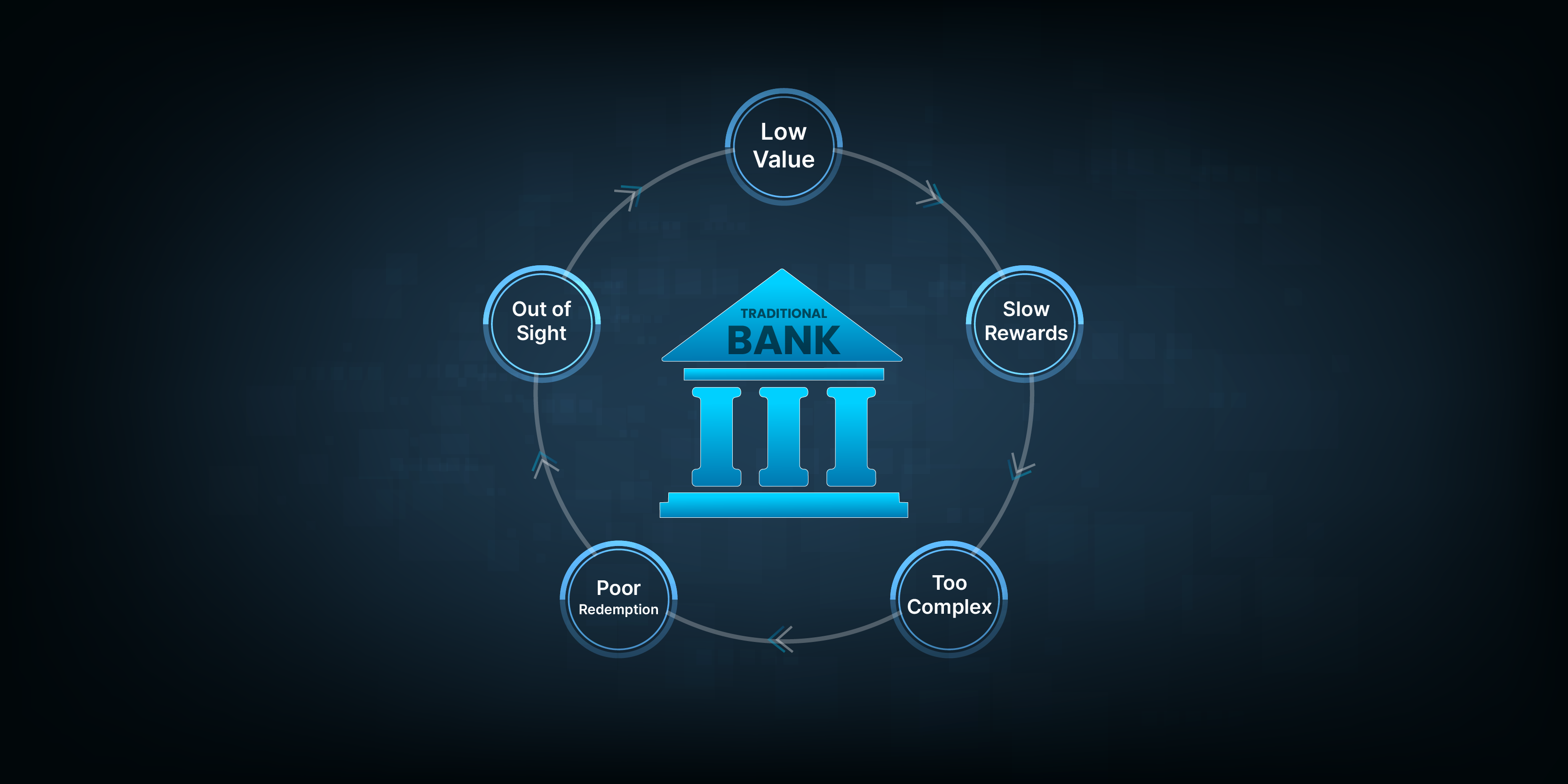
Traditional bank rewards underperform because they often focus on the transaction, not the relationship. A customer receives a cashback message, completes one payment and moves on. The reward does not necessarily teach the customer to return, explore another product or deepen the banking relationship.
McKinsey’s loyalty guidance states that loyalty programmes need core earn and burn functionality with the ability to personalise at scale. Traditional bank rewards often miss that second requirement. They offer the same benefit to broad customer groups, regardless of product usage, lifecycle stage or behavioural intent.
Traditional Rewards vs Repeat Usage Loyalty
Deloitte’s 2024 Consumer Loyalty Survey found that consumers value financial rewards, simplicity and ease of use, with 86% rating these attributes as important or very important. It also found that four out of five consumers value flexibility when earning and redeeming rewards. This explains why narrow, hard-to-use or unclear bank rewards struggle to build repeat behaviour.
What Drives Repeat Banking Engagement?
Repeat banking engagement comes from relevance, habit formation, trust and visible value. Banking customers repeat behaviours when a reward journey fits how they already manage money, make payments, save, borrow, travel or spend. A reward that interrupts this pattern may create curiosity. A reward that fits the pattern can build habit.
McKinsey’s personalisation research shows that companies that excel at personalisation generate 40% more revenue from personalisation activities than average players. For banks, this means loyalty should connect customer data with product usage, payment behaviour and timely offers.
The REPEAT Framework for Banking Engagement
UPI’s scale reinforces the need for this discipline. Customers transact frequently, but they do not necessarily stay loyal to one provider because of frequency alone. Payment-led loyalty must reward repeated, preferred and profitable behaviour, not only isolated usage.
The strongest banking engagement models reward actions such as first digital transaction, repeat monthly usage, bill payment completion, card spend growth, dormant account reactivation, product adoption and timely repayment.
Why Does Cashback Alone Fail to Build Banking Loyalty?
Cashback alone fails because it is easy to copy, easy to compare and often disconnected from the wider banking relationship. Customers may appreciate a cashback offer, but they may not feel recognised, understood or motivated to deepen their engagement.
Bain’s retention research shows that increasing customer retention by as little as 5% can boost profits by as much as 95%. That makes it risky for banks to treat rewards as acquisition discounts rather than retention investments.
Cashback-Led Rewards vs Relationship-Led Loyalty
Forrester’s loyalty thinking stresses that brands should measure both behavioural and emotional loyalty because transactions alone do not explain why customers stay. In banking, this distinction matters. A customer may transact because of convenience, salary credit or temporary cashback. Repeat loyalty requires a stronger reason to continue choosing the bank.
A better model combines reward value with lifecycle progression. For example, a bank can reward first payment activation, then repeat usage, then product depth, then high-value retention. This turns rewards into a journey rather than a discount.
How Should Banks Redesign Rewards for Repeat Usage?
Banks should redesign rewards around customer behaviour, not campaign calendars. A traditional bank rewards campaign may ask, “What offer can we send this month?” A repeat usage strategy asks, “Which behaviour should this customer repeat next?”
McKinsey’s retail banking research argues that banks should focus on customer primacy and margin protection while adopting digital technologies and AI. Loyalty redesign should follow the same logic: improve customer relevance without losing commercial control.
Banking Rewards Redesign Guide
Banks should also shift from static offer eligibility to dynamic segmentation. A dormant customer, a frequent UPI user, a premium cardholder and a salary account customer need different triggers and reward types.
The Reward Store’s integrated storefront supports this by giving customers reward access across categories such as gift cards from 5,000+ brands, flight bookings, hotel bookings, dining, golf, sports, experiences, merchandise, bus bookings and concierge services. Broader choice helps banks make redemption feel relevant across different customer groups.
Which Metrics Reveal Whether Bank Rewards Drive Repeat Usage?
Marketing leaders should measure repeat usage, not only offer redemption. Redemption proves that customers claimed value. Repeat usage proves that the reward helped change behaviour.
Deloitte’s loyalty research highlights simplicity, flexibility and digital-centric experiences as important customer expectations. If a bank’s reward programme has low redemption, long delays to first burn or weak repeat usage after reward claim, the programme may be creating activity without loyalty.
Repeat Usage Measurement Dashboard
Banks should compare rewarded customers against control cohorts. A gross transaction increase may not prove loyalty impact if similar non-rewarded customers grew at the same rate. The stronger measure is incremental repeat usage among exposed customers.
A useful formula is:
Repeat usage lift = repeat activity among rewarded customers minus repeat activity among comparable non-rewarded customers
This gives marketing leaders a clearer view of whether rewards influence behaviour or simply subsidise transactions that would have happened anyway.
How Can Rekyndl Help BFSI and Fintech Brands Improve Repeat Usage?
Rekyndl helps BFSI and fintech brands move from one-off rewards to automated loyalty journeys. Through Rekyndl for Financial Services and Fintech, marketing teams can design behaviour-led campaigns for activation, repeat transactions, redemption, reactivation, cross-sell and retention.
Rekyndl can support BFSI loyalty journeys such as:
- First digital transaction rewards.
- UPI or card repeat usage missions.
- Monthly transaction streak rewards.
- Dormant customer win-back journeys.
- Premium customer tier access.
- Points balance and redemption reminders.
- Product adoption campaigns.
- Lifecycle-based loyalty nudges.
McKinsey notes that personalisation depends on data-led relevance. Rekyndl supports that approach by helping marketers connect customer segments, behavioural triggers and reward journeys in one loyalty workflow.
Relevant internal resources include Rekyndl Features, Rekyndl Consumer Loyalty Overview and TRS X Storefront API.
The strategic benefit is control. Banks can reward the behaviours they want to grow, track which journeys perform and optimise repeat engagement without relying only on generic cashback.
What Mistakes Should Banking Marketers Avoid?
Banking marketers should avoid treating rewards as isolated campaigns. A one-off offer may lift activity for a few days, but it does not automatically create a repeat usage habit.
Common Bank Reward Mistakes
Mistake 1: Rewarding every transaction equally.
This can increase cost without improving profitable behaviour.
Mistake 2: Treating cashback as loyalty.
Cashback can drive action, but it does not necessarily deepen the customer relationship.
Mistake 3: Ignoring redemption friction.
Customers lose interest when rewards are hard to find, understand or use.
Mistake 4: Using broad segments only.
Mass messaging misses differences between new, dormant, active, premium and multi-product customers.
Mistake 5: Measuring campaign success too early.
A spike in transactions may fade unless the programme builds repeat behaviour.
Mistake 6: Failing to connect rewards with product strategy.
Rewards should support activation, usage, cross-sell, retention or reactivation, not sit outside commercial priorities.
Bain’s retention economics make this discipline important. If retention creates significant profit upside, banks should design rewards around repeat relationship value, not only campaign response.
Frequently Asked Questions
Why do traditional bank loyalty programmes underperform?
Traditional bank loyalty programmes underperform when they rely on generic cashback, limited redemption choice and one-off campaigns. They often reward a transaction without creating a reason for the customer to return, redeem or deepen the banking relationship.
What drives repeat banking engagement?
Repeat banking engagement comes from relevant rewards, simple earn and burn mechanics, timely triggers, trust, personalisation and visible value. Banks should reward behaviours such as repeat payments, digital adoption, product holding, timely repayment and reactivation.
How can banks move beyond cashback rewards?
Banks can move beyond cashback by creating behaviour-led journeys, tier benefits, points-based rewards, redemption nudges and personalised offers. A broader reward catalogue also helps customers find value that fits their lifestyle rather than only receiving transaction discounts.
When should banks reward repeat usage?
Banks should reward repeat usage when customers complete high-value behaviours, such as repeated monthly transactions, first product adoption, dormant return, card spend growth or tier progression. The timing should connect the reward to the behaviour while the customer still understands the value.
Can Rekyndl help BFSI brands build repeat usage journeys?
Yes. Rekyndl helps BFSI and fintech brands create automated loyalty journeys for activation, repeat usage, reactivation, redemption and retention. It connects customer behaviour with marketing automation and The Reward Store’s integrated reward catalogue.
What metrics show whether bank rewards are working?
Banks should track repeat transaction rate, monthly active users, product holding, redemption rate, time to first redemption, dormant reactivation, post-redemption usage, churn reduction and customer lifetime value. These metrics show whether rewards create behaviour change, not only offer claims.
Conclusion
Traditional bank rewards fail to drive repeat usage when they depend on generic offers, one-off cashback and limited redemption choice. Repeat banking engagement needs a stronger design: relevant triggers, simple earn and burn mechanics, broader reward access and cohort-level measurement. McKinsey, Deloitte and Bain all point towards the same strategic lesson: loyalty works when it combines personalisation, flexibility and retention economics.
The next phase of BFSI loyalty will reward banks that move from campaign incentives to automated customer journeys. Marketing leaders who make that shift will build stronger digital engagement and more profitable customer relationships.
Ready to replace one-off bank rewards with repeat usage journeys?
Explore how Rekyndl helps BFSI and fintech brands automate loyalty campaigns, personalise engagement and connect customers to meaningful reward choices.
Explore Rekyndl for BFSI and Fintech Loyalty
Sign up for our newsletter for trending top content!


