
Why Indian Schools and EdTech Companies Lose Good Teachers and How Recognition Programmes Change That

Sign up for our newsletter for trending top content!
Teacher attrition has become one of the most expensive workforce challenges facing India's education sector. According to Gallup, employees who do not feel recognised are twice as likely to consider leaving their organisation. In education, where institutional knowledge, student relationships, and academic continuity directly influence outcomes, every departure carries a significant operational cost.
Schools and EdTech companies invest heavily in recruitment, onboarding, training, and capability development. Yet many continue to lose experienced educators because they overlook one of the strongest drivers of retention: recognition.
For HR leaders, the challenge extends beyond salary competitiveness. Teachers increasingly seek appreciation, belonging, wellbeing, and visible career value.
This article explores what current research reveals about teacher retention, why recognition matters more than many organisations realise, and how structured recognition programmes can help schools and EdTech companies retain high-performing educators while strengthening culture across teaching and support teams.
The Teacher Retention Crisis: What the Data Shows About Why Educators Leave
Teacher turnover has accelerated globally, and India faces many of the same pressures. Research from McKinsey highlights that employee burnout, lack of appreciation, limited career development, and poor workplace culture consistently rank among the leading reasons people leave organisations.
Within education, the consequences are particularly severe. Every teacher departure disrupts student learning continuity, increases recruitment costs, and places additional pressure on remaining staff. SHRM estimates that replacing an employee can cost between six and nine months of their salary when recruitment, onboarding, training, and productivity losses are considered.
Recognition Deficits Often Sit Beneath Retention Problems
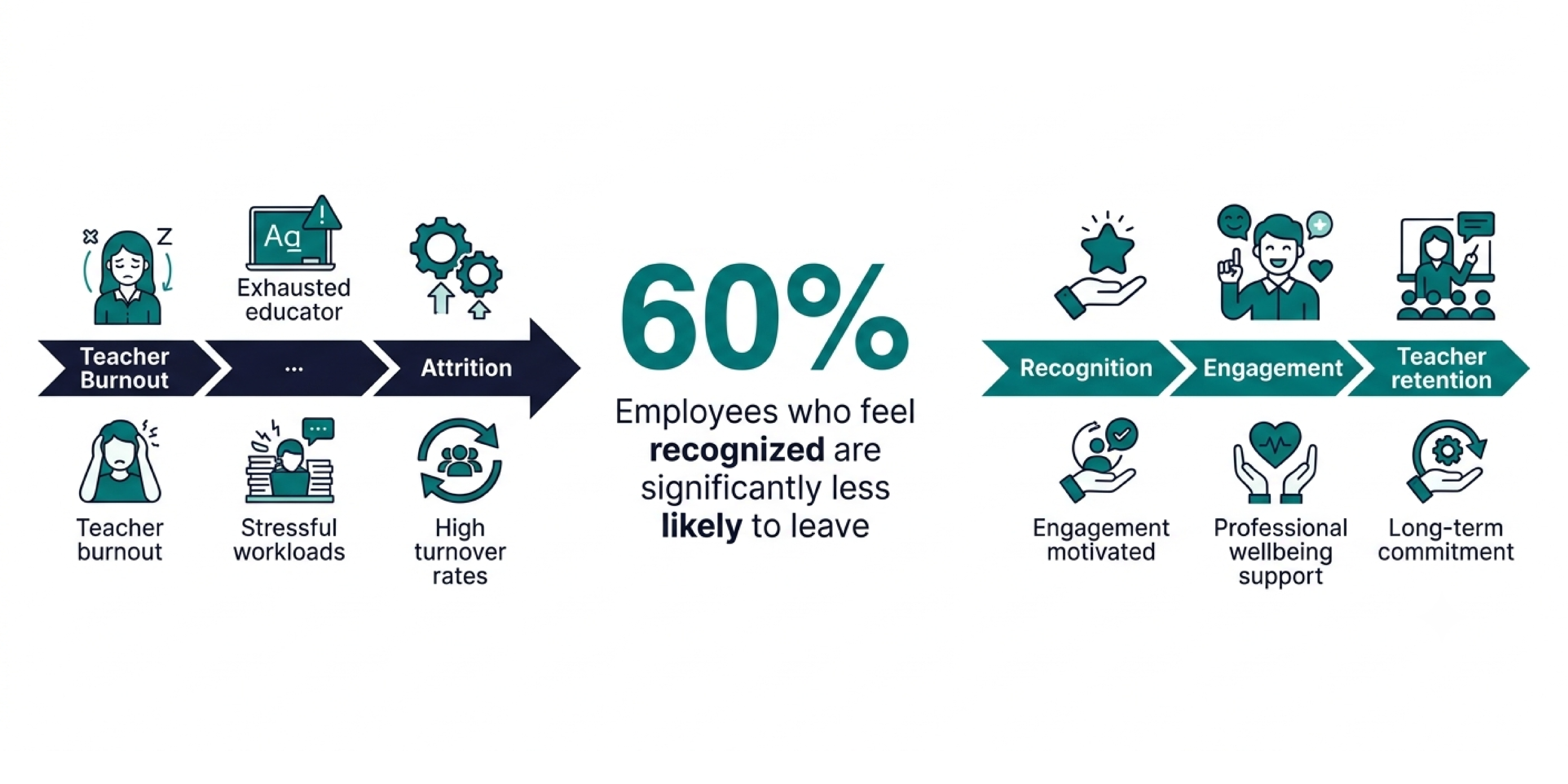
O.C. Tanner's Global Culture Report found that employees who receive meaningful recognition are significantly less likely to seek employment elsewhere. The study also found stronger engagement, improved wellbeing, and higher organisational commitment among recognised employees.
For schools and EdTech companies, attrition often appears as a compensation issue on the surface. However, employee listening exercises frequently reveal deeper concerns:
- Feeling invisible despite strong performance.
- Limited appreciation from peers and leadership.
- Lack of celebration for academic achievements.
- Emotional exhaustion and burnout.
- Minimal connection to organisational purpose.
Gallup research further shows that employees who receive regular recognition report higher engagement and stronger intent to stay. When educators invest emotional energy into student outcomes without receiving acknowledgement, disengagement often follows.
HR leaders who focus exclusively on compensation may therefore miss a significant retention opportunity. Recognition addresses emotional commitment, which salary alone cannot sustain.
Beyond Salary: What Teachers Say Would Make Them Stay
.png)
Compensation remains important, but research consistently shows that salary is only one component of retention.
According to Deloitte's Global Human Capital Trends research, employees increasingly prioritise purpose, appreciation, wellbeing, growth opportunities, and workplace relationships when evaluating long-term career decisions. Education professionals are no exception.
What Retention Drivers Matter Most?
The table highlights a crucial insight: recognition consistently appears alongside compensation rather than beneath it.
Recognition Creates Visible Value
Teachers dedicate substantial effort outside classroom hours. Lesson preparation, student mentoring, parent communication, curriculum design, assessment reviews, and extracurricular activities often go unnoticed.
When organisations create formal mechanisms to celebrate these contributions, employees gain visible proof that their work matters.
This is where structured platforms such as ApplaudIQ become particularly valuable. HR teams can automate milestone recognition, celebrate achievements across departments, enable peer appreciation, and ensure consistent acknowledgement regardless of location or institution size.
Recognition should not replace compensation strategy. Instead, it strengthens the emotional connection that helps educators remain committed even during demanding academic periods.
For additional insights into employee recognition strategy, explore:
https://www.therewardstore.com/applaudiq/
How Peer Recognition Between Teaching Staff Builds the Community That Retains People
Many recognition programmes focus exclusively on manager-to-employee appreciation. Yet peer recognition often delivers equally powerful retention benefits.
Gallup research indicates that employees highly value recognition from colleagues because peers witness daily effort, collaboration, and contribution more closely than senior leadership.
Why Peer Recognition Works in Academic Environments
Teaching can feel isolating despite being highly collaborative. Educators frequently spend most of their day in classrooms, interacting primarily with students rather than colleagues.
Peer recognition helps bridge this gap by creating visible appreciation across departments and teams.
Examples include:
- Recognising mentorship support for new teachers.
- Celebrating collaborative curriculum development.
- Acknowledging assistance during examinations.
- Highlighting innovative teaching methods.
- Appreciating cross-functional contributions.
O.C. Tanner research shows that organisations with strong peer recognition cultures experience higher belonging and stronger workplace relationships.
Building Community Through Recognition
Schools and EdTech companies often invest heavily in professional development while underinvesting in community building.
Recognition strengthens social bonds because it reinforces positive behaviours publicly. Over time, employees begin to associate organisational culture with support rather than pressure.
ApplaudIQ's peer-to-peer recognition capabilities allow colleagues to recognise contributions instantly through structured recognition workflows, social appreciation feeds, and visible celebration channels. Features such as leaderboards and Walls of Appreciation help sustain engagement throughout the academic year rather than concentrating recognition around annual events.
For HR leaders seeking long-term retention gains, community building deserves the same strategic attention as recruitment and training.
Academic Milestone Recognition: Celebrating the Moments That Matter in an Educator's Year
Not every recognition moment requires exceptional performance. Some of the most effective programmes recognise meaningful milestones that reflect an educator's journey.
According to SHRM, milestone recognition contributes significantly to employee loyalty because it reinforces a sense of progression and belonging within the organisation.
Milestones Worth Recognising
Academic institutions have unique recognition opportunities throughout the year:
Professional Milestones
- Work anniversaries.
- Teaching certifications.
- Academic qualifications.
- Promotion achievements.
- Leadership appointments.
Academic Contributions
- Curriculum innovation.
- Student success outcomes.
- Research contributions.
- Mentorship achievements.
- Programme launches.
Community Impact
- Student wellbeing initiatives.
- Parent engagement excellence.
- Diversity and inclusion contributions.
- Volunteer activities.
Consistency Matters More Than Scale
Mercer research suggests that employees value consistency of appreciation more than occasional large rewards.
A teacher whose contributions receive regular acknowledgement throughout the year often feels more connected than someone recognised only during annual ceremonies.
Modern recognition platforms simplify this process by automating milestone tracking and triggering personalised celebrations. HR teams can connect recognition workflows to HRMS systems, ensuring achievements never go unnoticed.
For education organisations managing multiple campuses or distributed teaching teams, automation helps maintain fairness and consistency while reducing administrative burden.
Wellness Rewards for Burnout Prevention: What Works for High-Stress Academic Environments
Burnout remains one of the strongest predictors of employee turnover.
According to Deloitte's workplace wellbeing research, burnout significantly reduces engagement, productivity, and retention. Educators face particularly high emotional demands due to student expectations, parental communication, administrative responsibilities, and performance pressures.
Recognition and Wellbeing Are Closely Connected
Many organisations treat recognition and wellbeing as separate initiatives. Research from Gallup suggests they are deeply linked.
Employees who feel valued report:
- Lower stress levels.
- Stronger resilience.
- Greater workplace satisfaction.
- Higher commitment to organisational goals.
Recognition acts as a protective factor against emotional exhaustion because it reinforces purpose and achievement.
Wellness Rewards That Support Educators
Effective teacher retention recognition programmes often include:
- Experiential rewards.
- Wellness-focused benefits.
- Flexible reward choices.
- Personal development opportunities.
- Lifestyle and leisure experiences.
The key principle is relevance. Different educators value different forms of appreciation.
Rather than prescribing rewards centrally, organisations achieve stronger outcomes when employees can select rewards that align with their personal interests and circumstances.
Recognition combined with meaningful reward choice creates a more holistic retention strategy than either initiative alone.
How to Build a Recognition Programme That Reaches Non-Teaching and Support Staff Equally
Many education organisations unintentionally focus recognition efforts on teaching staff while overlooking administrative, operations, finance, IT, facilities, admissions, and student support teams.
This creates inequity and weakens culture.
According to Gartner, inclusive recognition programmes generate stronger employee engagement because they reinforce the value of every role contributing to organisational success.
A Simple Recognition Framework
Step 1: Define Recognition Categories
Create categories relevant to all functions, such as:
- Collaboration.
- Innovation.
- Service excellence.
- Student impact.
- Leadership.
- Team contribution.
Step 2: Enable Multiple Recognition Sources
Recognition should come from:
- Managers.
- Peers.
- Senior leadership.
- Cross-functional teams.
Step 3: Standardise Visibility
Every employee should have equal opportunity to receive recognition regardless of department.
Step 4: Connect Recognition to Rewards
Reward flexibility helps ensure relevance across different employee groups.
Step 5: Measure Outcomes
Track:
- Recognition frequency.
- Participation rates.
- Employee engagement.
- Retention metrics.
- Programme adoption.
ApplaudIQ supports these objectives through automated recognition journeys, peer appreciation workflows, HRMS integrations, global reward fulfilment, and analytics dashboards that help HR leaders monitor programme effectiveness across teaching and non-teaching populations.
Learn more about recognition strategies for distributed workforces:
https://www.therewardstore.com/applaudiq/solutions/education-edtech
Frequently Asked Questions
What is a teacher retention recognition programme?
A teacher retention recognition programme is a structured initiative that acknowledges educator contributions, milestones, achievements, and positive behaviours. Its primary goal is to improve engagement, strengthen belonging, and reduce voluntary turnover. Effective programmes combine recognition, rewards, communication, and measurement.
How does recognition improve teacher retention?
Recognition increases employees' sense of value and connection to their organisation. Gallup research shows that employees who receive meaningful recognition demonstrate higher engagement and stronger intent to stay. In education environments, recognition helps reinforce purpose and commitment during demanding periods.
Why is peer recognition important in schools?
Peer recognition creates stronger social connections between educators and support teams. Colleagues often observe contributions that managers may not see directly. Public appreciation strengthens community, collaboration, and belonging, all of which support retention.
When should schools recognise teachers?
Schools should recognise teachers throughout the year rather than relying solely on annual awards. Key opportunities include work anniversaries, certification achievements, academic successes, mentoring contributions, innovation initiatives, and student impact milestones.
Can ApplaudIQ support teacher recognition across multiple campuses?
Yes. ApplaudIQ enables schools and EdTech organisations to automate milestone recognition, support peer-to-peer appreciation, integrate with HRMS systems, and provide access to a global rewards catalogue. This helps organisations maintain consistency and fairness across distributed teams and multiple locations.
Conclusion
Teacher retention challenges rarely stem from salary alone. Research from Gallup, Deloitte, McKinsey, SHRM, and O.C. Tanner consistently shows that appreciation, belonging, wellbeing, and recognition influence long-term commitment just as strongly as compensation.
Schools and EdTech organisations that build structured recognition programmes create stronger cultures, healthier teams, and more stable teaching environments. As workforce expectations continue to evolve, recognition will become a core component of talent retention strategy rather than an optional engagement initiative.
.png)
See how ApplaudIQ helps schools and EdTech companies reduce teacher attrition through structured recognition, milestone rewards, and peer appreciation programmes. Visit: https://www.therewardstore.com/applaudiq/solutions/education-edtech
Sign up for our newsletter for trending top content!


