
The Shift from Static Gift Lists to Dynamic Reward Marketplaces

Sign up for our newsletter for trending top content!
Introduction
Forrester reports that 77% of consumers expect personalised experiences from brands they engage with, yet most loyalty and incentive programmes still operate on fixed catalogues last refreshed quarterly. The result: Bond's Loyalty Report finds that only 22% of members are highly satisfied with the personalisation of their rewards, and redemption rates across traditional programmes stagnate below industry benchmarks.
For marketing leaders running consumer loyalty, channel partner, or customer retention programmes, this gap is no longer cosmetic. It directly affects redemption velocity, repeat purchase rates, and the ROI marketing finance teams demand. This post examines why static gift lists underperform, what a dynamic reward marketplace actually is, how it changes redemption economics, and the framework marketing leaders should use to evaluate the shift.
Why Do Static Gift Catalogues Underperform in Modern Loyalty Programmes?
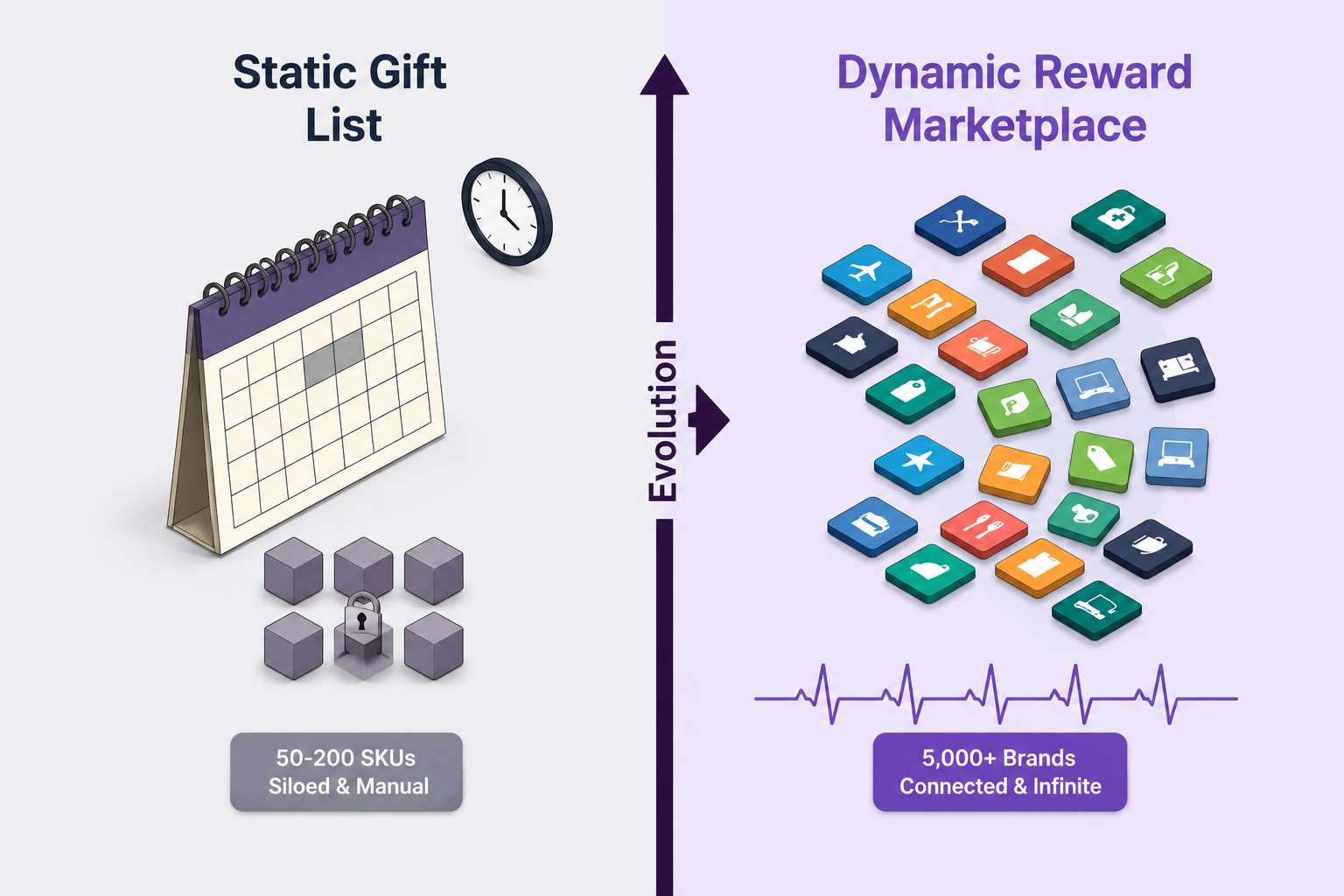
Static gift lists were designed for a procurement era, not a customer-experience era. They typically contain 50–200 fixed SKUs negotiated annually, displayed in a uniform grid regardless of who the recipient is. The structural problems are well documented.
McKinsey's research on loyalty economics found that 71% of consumers expect companies to deliver personalised interactions, and 76% get frustrated when this does not happen. A fixed catalogue cannot meet this expectation by definition — it offers the same options to a 24-year-old urban professional and a 55-year-old enterprise customer.
Deloitte's Global Marketing Trends report shows that brands leading on personalisation grow revenues 40% faster than laggards. Yet static lists actively work against personalisation: they limit choice, fail to refresh based on consumer trends, and ignore regional preferences entirely. For multi-country programmes, the problem compounds — a single catalogue cannot serve Bengaluru, Dubai, and Singapore audiences with equal relevance.
The downstream effect is breakage masquerading as efficiency. Programmes report low redemption as cost savings, when in reality it signals disengaged members who are unlikely to repurchase. Aberdeen Group research links low redemption rates to a 23% decline in programme participation year-on-year.
What Is a Dynamic Reward Marketplace and How Does It Differ?
A dynamic reward marketplace is a continuously updated, personalised storefront where members redeem points, vouchers, or incentives across thousands of options spanning multiple categories. Unlike a static list, the marketplace adapts in three ways:
Catalogue breadth and refresh cadence. Where a static list holds 50–200 items, a dynamic marketplace typically offers 5,000+ brands across gift cards, flights, hotels, dining, experiences, merchandise, and concierge services. New options are added continuously rather than annually.
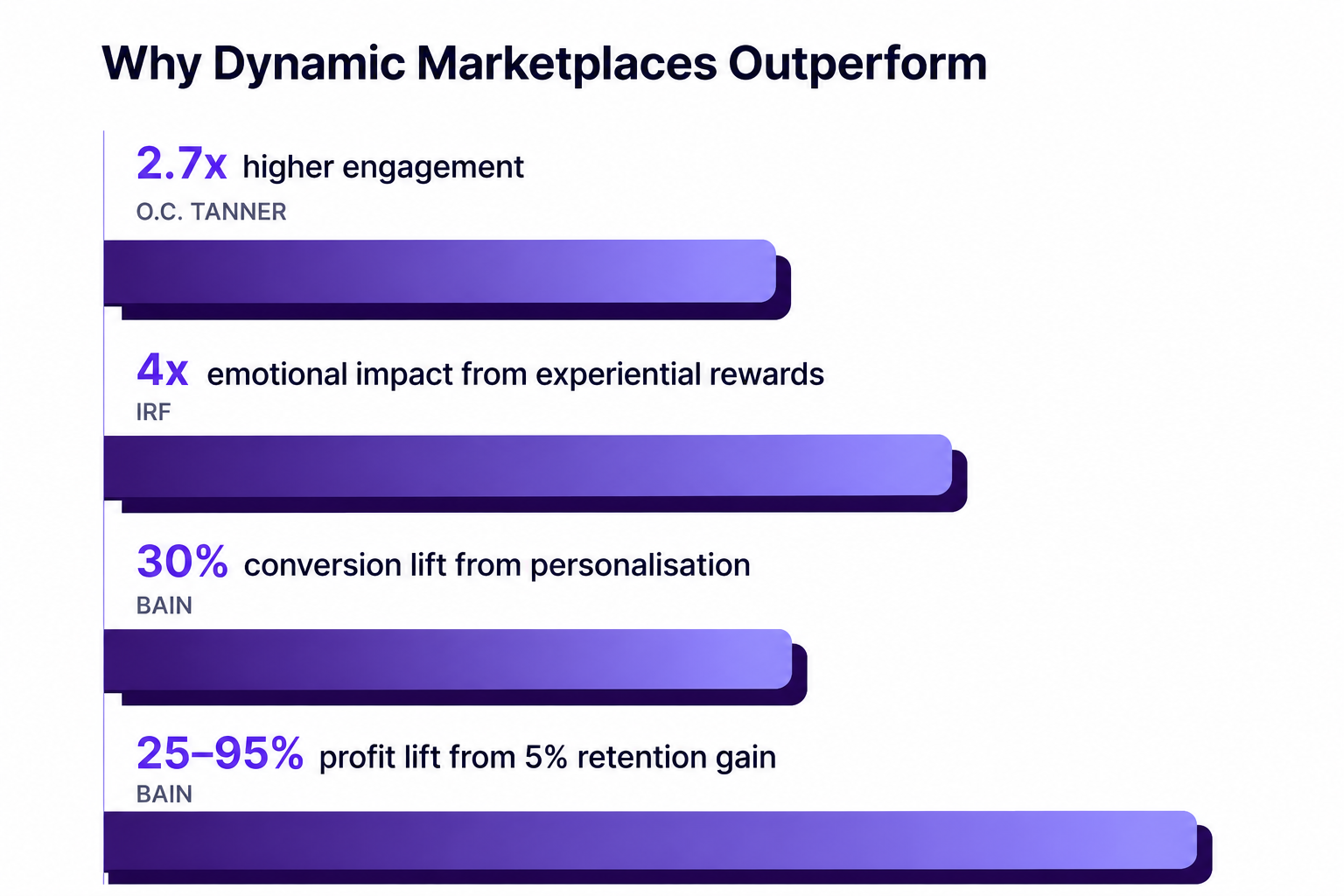
Personalisation engine. Recommendations are driven by user behaviour, demographic data, and redemption history rather than a fixed display order. Bain & Company reports that personalised recommendations can increase conversion rates by up to 30%.
Geographic and category flexibility. A single marketplace can serve global audiences with locally relevant options, eliminating the need for region-specific catalogues.
The shift is not about adding more SKUs. It is about replacing a transactional procurement model with an experience platform.
How Does a Dynamic Marketplace Improve Redemption Rates and Programme ROI?
The economic case rests on three measurable outcomes: higher redemption, longer member tenure, and stronger repeat purchase behaviour.
O.C. Tanner's Global Culture Report consistently finds that programmes offering meaningful, personalised rewards see engagement rates 2.7x higher than those relying on generic vouchers. For consumer loyalty, this translates directly to redemption velocity — the speed at which earned points are converted into rewards, which is the strongest predictor of repeat purchase.
The Incentive Research Foundation (IRF) reports that experiential rewards drive 4x the emotional engagement of cash equivalents of the same value. A dynamic marketplace, by including travel, dining, and experiential categories, captures this engagement premium that a gift-card-only list cannot.
Bain & Company's loyalty research shows that a 5% increase in customer retention correlates with a 25–95% increase in profits. Dynamic marketplaces affect retention through three mechanisms: members redeem more often (reducing breakage), members stay engaged longer (extending lifetime value), and members associate the brand with positive experiences rather than transactional discounts.
For marketing leaders, this reframes the budget conversation. A reward marketplace is not a procurement line item — it is a retention infrastructure investment with measurable revenue impact.
What Should Marketing Leaders Evaluate When Moving from Static to Dynamic?

Use this five-point framework when evaluating the shift:
1. Catalogue depth and refresh. Verify how many brands are available, across how many categories, and how frequently new options are added. A marketplace with fewer than 1,000 brands or no travel and experiential categories will struggle to differentiate from a static list.
2. Personalisation capability. Ask how recommendations are generated. Behaviour-driven personalisation should be native, not an add-on. Forrester research shows personalised experiences increase customer satisfaction scores by 20% on average.
3. Multi-geography support. For brands operating across India, Southeast Asia, the Middle East, or globally, the marketplace must serve each region with locally relevant options and currencies natively.
4. Integration with marketing automation. The marketplace should connect to your CRM, loyalty engine, and campaign tools — not exist as a parallel system. Programmes with marketing automation built in see 14.5% higher sales productivity, according to Nucleus Research.
5. Reporting and ROI attribution. Demand programme-level analytics: redemption rates by segment, points liability, repeat purchase lift, and revenue attribution. Without these, the marketplace cannot be optimised.
The Reward Store's TRS-X integrated storefront was designed against this framework, combining a 5,000+ brand catalogue with Rekyndl's marketing automation for consumer loyalty programmes.
Frequently Asked Questions
What is a dynamic reward marketplace?
A dynamic reward marketplace is a continuously updated, personalised storefront where loyalty members redeem points across thousands of options including gift cards, flights, hotels, dining, experiences, and merchandise. Unlike static gift lists, the catalogue refreshes constantly and recommendations adapt to each member's behaviour, demographic profile, and redemption history.
How does a dynamic marketplace improve redemption rates compared to a fixed gift list?
Dynamic marketplaces lift redemption by addressing the two reasons members do not redeem: limited relevance and limited choice. Bond's Loyalty Report shows that programmes offering personalised, varied reward options see redemption rates significantly above the industry benchmark. By covering 8+ reward categories and 5,000+ brands, members find options that match their actual preferences rather than settling for the closest available SKU.
Why are static gift lists still common if dynamic marketplaces perform better?
Static lists persist because they are simpler to procure and easier to budget. Marketing teams inherited them from procurement-led reward programmes designed in the 2000s. The shift to dynamic marketplaces requires viewing rewards as a marketing investment with retention ROI, not a procurement cost — a reframing many organisations are still working through.
Can a dynamic reward marketplace work for global loyalty programmes across multiple countries?
Yes, and this is where dynamic marketplaces show their strongest advantage. A single platform like The Reward Store's TRS-X storefront, integrated with Rekyndl, serves 250+ clients across 120+ countries with locally relevant rewards and currencies. Marketing leaders avoid the cost and complexity of managing region-specific catalogues separately.
How should marketing leaders measure success after switching to a dynamic marketplace?
Track four metrics: redemption rate (target above industry benchmark for your sector), repeat purchase lift among redeemers versus non-redeemers, member tenure (months from enrolment to last redemption), and revenue attribution from loyalty-driven transactions. Aberdeen Group research suggests these metrics should show measurable improvement within two quarters of migration.
Conclusion
Static gift lists were built for a different era of marketing one where catalogues were procurement decisions and customer choice was a constraint, not a value. Today's marketing leaders operate in an environment where personalisation, breadth, and experiential value directly drive retention economics. The dynamic reward marketplace is the structural answer to that shift, and the data from McKinsey, Bain, Forrester, and the IRF all point the same direction. The brands that move first will define how loyalty programmes are evaluated for the next decade.
See how The Reward Store's TRS-X storefront and Rekyndl marketing automation transform static catalogues into dynamic, personalised reward marketplaces for global loyalty programmes. Explore the TRS-X integrated storefront →
Sign up for our newsletter for trending top content!


