
Physical Diwali Gift Cards: Design, Packaging and In Store Distribution Decisions

Sign up for our newsletter for trending top content!
Physical Diwali gift cards for retail work when the card is designed to be handed over as a gift, packaged to survive shelf handling, ordered early enough to clear production and distribution before shoppers begin buying, and activated only at the till. The decisions are made in that order because each constrains the next: packaging fixes the card format, the format fixes the production schedule, and the schedule fixes the stock that stores can hold. Where the production window has already closed, a digital card is the correct choice.
Why Physical Gift Cards Still Sell at Diwali
Physical gift cards still sell at Diwali because the festival is organised around handing something to another person, and a card can be placed in a hamper, set beside a box of sweets or given at a doorstep visit. A digital card has to be forwarded, and a forwarded message carries less of the ceremony that the giver is paying for.
What a physical card does that a digital card cannot
The first advantage is presence. A giver visiting family or distributing gifts at an office event wants something to hand over, and a card gives that moment a focal point. The second is reach. Older relatives, household staff and site staff may not use email regularly or may not share a mobile number with the giver, and a physical card needs neither. The third is the store itself. A card at the till is bought by a shopper who has just realised that no single item suits the recipient, so the card captures a decision that would otherwise be abandoned.
When digital is the better choice
The counter argument is sound in many cases. A digital card carries no stock risk, can be issued on the day and can include a personal message. Physical cards tie up working capital before the season, can be lost in transit and leave unsold stock afterwards. The table sets out the deciding criteria.
Card Design and Packaging That Reads as a Gift
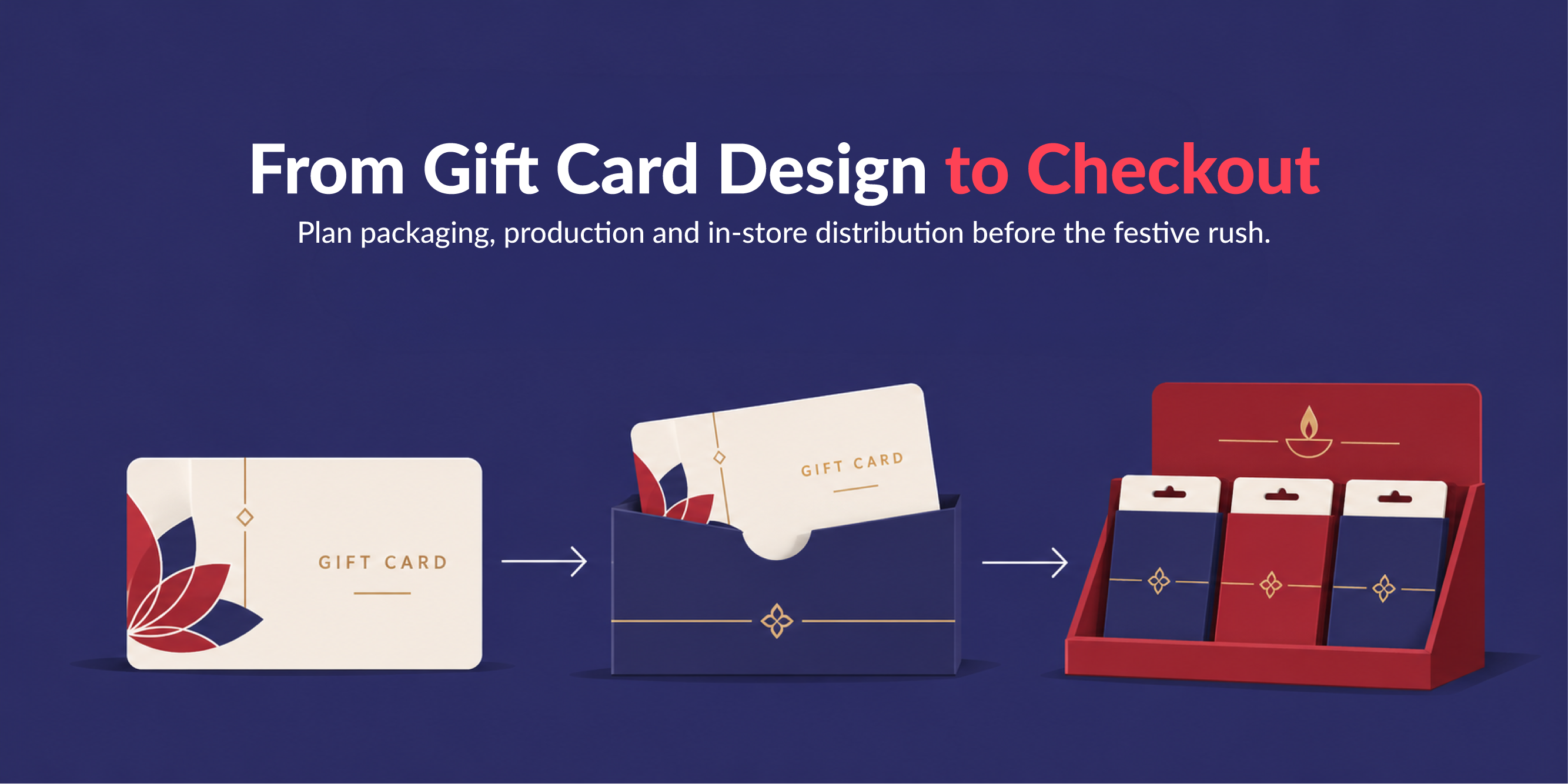
A physical gift card reads as a gift when the packaging carries the festive message and the card itself stays neutral enough to be used after the festival. A payment style card in a plain sleeve reads as a transaction, whereas the same card in a considered carrier reads as a present.
Designing the card face around its functional zone
A carrier is a printed folder or sleeve that holds the card and presents it as a gift. Keep the festive artwork on the carrier and treat the card face as a functional surface that holds the barcode or code panel, any scratch panel covering a PIN, the brand mark and a short terms line. Glossy lamination, foil and spot varnish near a barcode cause glare under till scanners, so the barcode needs a clear quiet zone and a scan test on the till hardware that stores actually use, not on a handheld scanner in the design studio.
Place any greeting that carries a year on the carrier. A card printed with the year becomes unusable stock after the festival, whereas a neutral card can be placed in a fresh carrier next season. Whether to use religious imagery on an object that is scanned, dropped and eventually discarded is a decision for the Brand Manager with cultural review, and many brands choose lamps, geometric rangoli patterns and colour instead.
Choosing a packaging format
A carrier that hides the barcode forces staff to open the pack at the till, which leaves the next buyer with damaged stock. Thickness matters for a second reason: it determines how many packs fit on a peg and in a till drawer, which limits how much stock a store can hold at the counter.
Production Lead Times and When to Order
Order physical cards as soon as the artwork, denominations and quantities are agreed, because physical production is a chain of dependent stages that cannot be compressed the way digital issuance can. Lead time is the elapsed time between approving an order and having stock available where it will be sold. A digital card can be issued on the day it is needed, which is why physical cards should be planned weeks before digital ones.
Working backwards from the shelf date
Fix the date on which cards must be on shelf. It falls before the first gifting purchases and not on Diwali itself, because givers who send gifts to other cities buy early. Then count backwards through this sequence.
- The shelf ready date is the date by which cards must be placed in every participating store.
- Store receipt and allocation follow, when the distribution centre splits stock by store and each store checks its cartons.
- Freight covers transit from the vendor to the distribution centre and onward to stores, and the longest route sets the schedule.
- Kitting is the insertion of cards into carriers and their packing into store sized cartons.
- Production and encoding cover printing, finishing and the loading of unique codes, which needs a secure file of codes to be generated and handed to the vendor.
- Proof and sign off require a digital proof and then a physical proof tested on tills, approved by brand, legal and store operations.
- Quantity, denomination and budget approval is the final decision on how many cards of each value are produced.
Delay usually enters at stage six rather than at the press. Each round of changes between brand, legal and the vendor restarts the approval loop, and a physical proof must travel between people.
Quantity is the decision that cannot be corrected later
A reprint restarts the whole chain, so the quantity ordered is effectively final for the season. Order the quantity that stores are confident of selling and cover the uncertain upside with digital issuance from a gift card issuance platform, which can add cards on demand without waiting for production.
When physical cards are the wrong choice
If counting backwards places the order date before today, do not shorten the proof stage to recover time. A rushed run without a till scan test can produce an entire batch that the cashier cannot scan, and the failure is discovered only when customers are queuing. Choose digital for this season and begin the physical schedule early for the next festival.
Store Placement, Stock and Staff Briefing
Place physical gift cards where the shopper is already deciding what to give, keep live cards inactive and behind the till until sold, and brief staff on activation, amount verification and errors. Activation is the step in which the cashier makes a card spendable at the point of sale after payment has been taken, so a card removed from a display cannot be spent.
Placement
Put a dummy pack, which is an empty carrier, beside categories with gift intent such as sweets, home furnishings and festive apparel, and keep the live cards at the till. The shopper who sees the dummy pack asks for the card at the counter. Placement is a trade off between visibility and loss, and the loss prevention manager should decide whether any live stock appears on the shop floor.
Stock allocation
Allocate by store footfall and gifting categories rather than equally, and agree in advance who may authorise transfers between stores. A store that sells out early in the gifting window loses sales that a quieter neighbour may not need. Record a serial range for each carton so that every store can count cards received, activated and returned, and so that the finance controller can reconcile the three.
Staff briefing
Brief cashiers and store managers on four points: activate only after payment is taken, read the amount back to the customer, explain validity and how to check the balance, and record the serial number of any card that fails to scan or activate. A useful diagnostic is to ask a cashier what they would do if the scanner rejects a card. A cashier who would swap in another card from the stack has not been told to record the serial number of the rejected one.
Running Physical and Digital Cards From One Campaign
Physical and digital cards can run from one campaign when the campaign holds the rules and the budget and the format is only a delivery choice. A campaign is a defined set of issuance rules, a budget and a reporting scope for one gift card initiative. A gift card issuance platform is a system that creates, funds and tracks gift cards and applies campaign rules to them.
Where the budget is counted
Decide with the finance controller whether a physical card counts against budget when it is printed or when it is activated. Counting at print time shows unsold stock as spent and starves later demand, while counting at activation reflects the value in circulation but leaves production cost to be tracked separately. Either rule works if it is applied to every format and recorded. The gift card issuance platform in use should apply that rule to both formats, because a rule kept in a spreadsheet drifts from the live figures.
An illustration of the single campaign model
Reward Factory is a gift card issuance platform from The Reward Store, with campaign management and budget governance built in. As an illustration of the single campaign model, it produces and distributes branded physical cards alongside digital issuance and manages both from one dashboard, with variable budgets per campaign and a spend cap that pauses issuance automatically. Redemption sits outside that model. It takes place where the card is accepted, and the point of acceptance authorises the transaction and deducts the balance.
A worked scenario
Consider a regional home furnishings retailer with stores in several states and a corporate sales team. The Brand Manager orders a fixed quantity of physical cards for the stores and sets one campaign budget. Shortly before the festival, a corporate customer asks for gift cards for a large staff group. Physical production cannot meet the date, so the corporate team issues digital cards from the same campaign. Because the budget sits at campaign level, finance sees physical activations and digital issuance in one report.
Had the formats held separate budgets, the digital allocation would have been exhausted while physical stock sat unsold in stores. Some finance teams prefer separate budgets so that physical overspend cannot consume digital funds, which is reasonable and is better handled by agreeing internal allocations within the campaign.
A Physical Gift Card Readiness Checklist
- Brand Manager: Confirm the shelf ready date and count backwards through each production stage to today.
- Brand Manager: Place any year specific greeting on the carrier and keep the card face neutral so that it can be reused.
- Brand Manager: Obtain cultural review of any religious imagery before artwork is sent for proof.
- Marketing: Scan test the physical proof on the till hardware used in stores, with the barcode under the final finish.
- Legal: Confirm the terms line and validity period, and confirm whether the card falls within the Reserve Bank of India framework for prepaid payment instruments.
- Finance Controller: Agree whether a card counts against budget at printing or at activation, and record the rule.
- Marketing: Set the quantity for each denomination at the level stores are confident of selling, and plan digital issuance for the uncertain remainder.
- Retail Operations Lead: Allocate stock by store and name who may authorise transfers.
- Retail Operations Lead: Record the serial range of every carton and count cards received, activated and returned.
- Store Manager: Place dummy packs beside gifting categories and keep live cards inactive at the till.
- Store Manager: Brief every cashier on activation after payment, reading back the amount, balance checks and rejected cards.
- Retail Operations Lead: Agree who reviews the campaign report each week and what triggers a transfer or an additional digital issuance.
Where Reward Factory Fits
A gift card issuance platform sits between the decision to run a gift card campaign and the till or screen where the card is accepted. It creates the cards, applies the campaign rules and budget, and records what has been issued.
The Reward Store provides Reward Factory as a gift card issuance platform. It issues and manages gift card programmes for retailers and brands across a store network of any size.
It produces and distributes branded physical cards alongside digital issuance, managed from one dashboard. Campaigns carry independent rules, budgets can vary by campaign, and a spend cap pauses issuance automatically. Issuance and campaign performance are tracked in real time. The platform reports the redemption status of cards it has issued. It does not operate redemption, and it does not issue loyalty points.
Frequently Asked Questions
How early should I order physical Diwali gift cards compared with digital ones?
Order physical cards as soon as artwork, denominations and quantities are agreed, and count backwards from the date they must be on shelf. Physical production passes through proofing, printing, encoding, kitting and freight, and each stage depends on the one before. Digital cards can be issued on the day they are needed, so the physical schedule should start weeks earlier than the digital one.
What makes a gift card look like a gift and not a payment card?
Packaging does most of the work. A printed carrier, which is a folder or sleeve that holds the card, carries the festive artwork and the greeting, while the card inside stays functional and neutral. A window that shows the barcode lets cashiers scan without opening the pack. Avoid year specific wording on the card itself so that leftover cards can be reused.
Should physical gift cards be activated at the till or sold already active?
Activate at the till after payment is taken. A card that is inactive until sold has no spendable value, so a card removed from a shelf or carton cannot be used. The cashier scans the card, confirms the amount with the customer and activates it at the point of sale. Cards sold already active move the theft risk to every place where stock is stored or displayed.
Where in the store should gift cards be displayed during Diwali?
Display dummy packs, which are empty carriers, beside categories where gifting decisions are made, such as sweets, home furnishings and festive apparel, and keep live cards at the till. This reaches the undecided shopper while keeping stock out of reach. Whether live cards may appear on the shop floor is a decision for the loss prevention manager, based on how the store handles theft.
Do Diwali gift cards in India fall under Reserve Bank of India rules?
It depends on the card. The Reserve Bank of India regulates prepaid payment instruments through a Master Direction, and the treatment varies with where the card can be used and who issues it. Issuers should ask their legal or compliance team to confirm whether a given card falls within that framework before artwork and terms are finalised, because the terms line is printed on the card.
Can physical and digital gift cards share one budget?
Yes, provided the budget sits at campaign level and the format is treated as a delivery choice. The finance controller must decide whether a physical card counts against the budget when printed or when activated, and apply the rule to every format. Counting at print time shows unsold stock as spent, whereas counting at activation reflects value in circulation.
Does Reward Factory support physical gift cards as well as digital?
Yes, Reward Factory is a gift card issuance platform that produces and distributes branded physical cards alongside digital issuance, with both managed from one dashboard. It also issues across channels in store, online and through partner channels, connected through a single API. It reports the redemption status of cards it has issued but does not operate redemption.
Sign up for our newsletter for trending top content!


