
How to Evaluate a Loyalty Technology Platform in 2026: A Framework for CXOs and Digital Leaders

.png)
Sign up for our newsletter for trending top content!
A 5 percent improvement in customer retention increases profits by 25 to 95 percent, according to research by Bain and Company published in Harvard Business Review. Most loyalty platform evaluations never test for the capability that actually produces that lift.
They test for feature checklists, demo polish, and headline pricing instead. For a CXO signing off on a multi-year platform contract, that is an expensive gap. A wrong platform choice does not just waste the licence fee. It costs the organisation a full replatforming cycle, typically eighteen to twenty four months, before retention economics start compounding again.
This guide sets out what to test for, how to structure build versus buy versus hybrid decisions, and how to run an evaluation process that surfaces real differences between platforms before the contract is signed, not after.
Why Loyalty Platform Evaluations Fail: The Evaluation Criteria That Do Not Predict Real World Outcomes
Most loyalty platform evaluations optimise for the wrong signal. Procurement teams weight demo quality, vendor brand recognition, and upfront licence cost heavily, and weight data architecture, personalisation depth, and integration debt lightly, if at all. This is backwards.
The Forrester Wave: Loyalty Platforms, Q4 2025 evaluated eleven significant loyalty platform vendors across twenty seven criteria and confirmed that platform differentiation between vendors is real and consequential for programmes that choose incorrectly. In other words, the platforms genuinely are not interchangeable, and a scorecard built around vanity criteria will not detect the difference until the programme is already live and underperforming.
The second failure mode is treating the evaluation as a one time event owned by marketing alone. A platform decision made without input from finance, IT, and data governance tends to surface hidden costs eighteen months in: unbudgeted integration work, data residency issues, or a redemption catalogue that cannot support the regions the business actually operates in.
Organisations that evaluate well build a weighted scorecard before the first vendor demo, involve the functions that will own the platform post launch, and score every vendor against the same criteria set rather than letting each vendor define the terms of comparison.
The Eight Capabilities a Loyalty Platform Must Have in 2026, and How to Test for Each
Forrester's Loyalty Platforms Landscape research recommends evaluating platforms on artificial intelligence and personalisation depth, real time processing power, omnichannel integration depth, scalability, data unification, and measurable impact on retention and lifetime value.
Building on that framework, eight capabilities separate platforms that deliver from platforms that stall at pilot stage. For a CXO level view of how these capabilities map to commercial outcomes rather than technical specifications, see Rekyndl for CXOs.
- Programme builder flexibility. Can marketing staff configure tiers, rules, and rewards without a development ticket.
- Behavioural segmentation. Faster growing companies derive 40 percent more of their revenue from personalisation than slower growing competitors, according to McKinsey research, and segmentation is the mechanism that enables this.
- Automated journey orchestration. Welcome, cart abandonment, birthday, and win back journeys should trigger without manual campaign builds.
- Gamification mechanics. Point scanning, spin mechanics, and badges, tested for genuine engagement lift rather than novelty.
- Redemption experience. Rekyndl pairs its loyalty engine with an integrated redemption storefront and a catalogue spanning 5,000+ gift cards across 100+ countries, so members redeem within the same experience where they earned.
- Multi channel delivery. Email, SMS, push, in app, and in store, unified under one customer profile.
- Data unification. A single customer record across commerce, support, and loyalty systems, not three partial views.
- Governance and compliance. Auditable data handling that satisfies procurement before it satisfies marketing.
Test each capability against the vendor's actual data, not a scripted demo, before any commercial conversation proceeds.
Build vs Buy vs Hybrid: The Updated Decision Framework for 2026
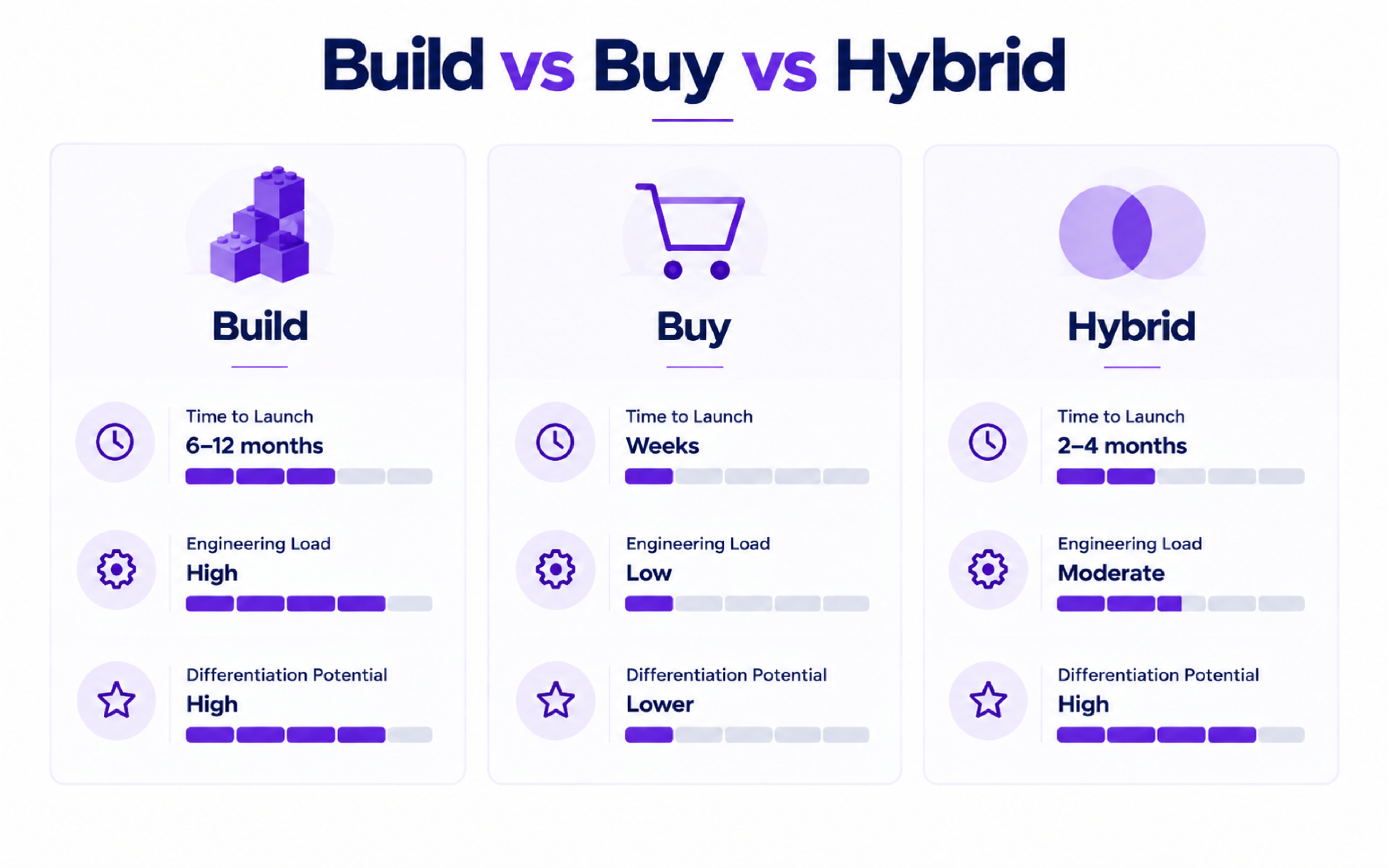
The build versus buy question has not gone away, but the calculus has shifted. Gartner's total cost of ownership research consistently cautions that the licence or development quote is only the starting point, and that ongoing maintenance, integration debt, and opportunity cost dominate the real multi year cost of any platform decision.
For loyalty specifically, the build case weakens further because the underlying capability, catalogue access, redemption logistics, and compliance, is not a differentiator most brands should be building in house.
For most CXOs outside pure loyalty businesses, a buy or hybrid approach concentrates engineering effort on the parts of the customer experience that are genuinely differentiated, rather than on rebuilding catalogue and redemption infrastructure that already exists at scale in the market.
Integration Architecture: What Your IT and Engineering Teams Should Evaluate Before Sign-Off
A loyalty platform lives or dies on how cleanly it connects to the systems around it: CRM, ecommerce, mobile app, and HRMS or POS where relevant. Deloitte's enterprise integration research notes that poorly defined integration is costly to manage and modify over time, and that project teams frequently duplicate point to point interfaces as they work in isolation, creating an integration estate that is expensive to maintain long after the original project team has moved on. This is the hidden cost that a headline licence fee never captures.
Before sign-off, IT and engineering should evaluate whether the platform offers a documented, versioned API rather than a bespoke integration built per client, whether it supports the organisation's existing identity and data governance model, and whether onboarding a new data source requires vendor engineering time or can be configured internally.
A platform that requires a vendor ticket for every new integration will not scale with the organisation. Ask for a reference architecture diagram rather than a marketing slide, and ask an existing client how long their most recent integration actually took from kickoff to production.
Vendor Risk Assessment: How to Evaluate a Loyalty Platform Vendor's Stability, Roadmap, and Support
A loyalty platform is a multi year commitment, and vendor risk deserves the same scrutiny as vendor capability. Four questions matter most.
First, funding and ownership stability: is the vendor privately held, venture backed, or part of a larger group, and what does that structure mean for product continuity over the life of the contract.
Second, roadmap transparency: does the vendor publish a public roadmap, or does every feature request disappear into an opaque backlog with no visible timeline.
Third, support model: is there a named implementation and success team accountable for outcomes, or a shared ticket queue with no continuity between conversations. Fourth, reference depth: will the vendor connect you with a client in your sector and region, not only a curated case study written for a website.
Deloitte's 2024 Consumer Loyalty Survey found that 70 percent of consumers already participate in paid loyalty programmes, which means the bar for a credible, well supported programme is rising alongside consumer expectations. A vendor that cannot demonstrate operational stability today is a poor bet for a programme that needs to earn consumer trust over several years, not one launch cycle.
The Evaluation Process: How to Run an RFP and Proof-of-Concept That Surfaces Real Differences Between Platforms
Start with a weighted scorecard built before any vendor conversation, covering the eight capabilities above plus integration architecture and vendor risk.
Score every vendor against the identical criteria set so comparisons are apples to apples rather than shaped by whichever vendor presented most recently. Aberdeen Group research found that 89 percent of customers are retained by companies with strong omnichannel strategies, so the RFP should test omnichannel delivery directly rather than accepting a feature list at face value.
The proof of concept stage is where genuine differences surface. Run it against the organisation's own data, not a vendor sandbox, and include at least one integration build during the proof of concept window, since implementation speed under real conditions is the single best predictor of implementation speed at full rollout.
Involve finance in the proof of concept debrief so total cost of ownership, not just licence price, informs the final decision. A properly run proof of concept typically takes four to six weeks and should end with a documented scorecard signed by every function involved, not an informal consensus reached in a hallway conversation after the final demo.
Frequently Asked Questions
What is the difference between a loyalty platform and a loyalty programme?
A loyalty programme is the set of rules, tiers, and rewards a business offers its customers. A loyalty platform is the technology that runs those rules at scale, automating segmentation, journeys, redemption, and reporting. Many organisations design a strong programme and then discover their platform cannot execute it.
How long does it typically take to launch a loyalty platform?
Timelines vary by build approach. A bought platform with a no code programme builder, such as Rekyndl, can typically go live in weeks rather than months, while a custom built platform commonly takes six to twelve months before the first member can enrol.
Why do loyalty programme evaluations often miss integration risk?
Evaluations are frequently run by marketing teams focused on programme mechanics, with IT and engineering brought in only after a vendor is shortlisted. This sequencing means integration architecture, the factor most likely to cause delay and hidden cost, is tested last rather than first.
Can a loyalty platform integrate with an existing CRM and ecommerce stack without custom development?
A well architected platform should connect through documented APIs rather than bespoke, one off integration work. This should be confirmed with a reference architecture diagram and a real client reference during evaluation, not taken on trust from a sales deck.
When should a CXO involve finance in a loyalty platform evaluation?
From the outset. Total cost of ownership, not licence price alone, determines whether a platform decision pays back within a reasonable period, and finance input during the proof of concept stage catches hidden costs before contract signature rather than after.
Conclusion
Loyalty platform evaluations fail when they test for demo polish instead of the capabilities that drive retention economics. The 2026 evaluation bar covers personalisation depth, integration architecture, and vendor stability together, scored against one weighted criteria set rather than three separate conversations run by three separate functions.
As AI driven personalisation becomes table stakes rather than a differentiator, the platforms that win will be the ones that were evaluated properly, on the organisation's own data, before the contract was signed.
Sign up for our newsletter for trending top content!


