
How HR Leaders Should Budget for an Employee Recognition Programme: A Practical Financial Planning Guide

.png)
Sign up for our newsletter for trending top content!
Gallup prices the cost of replacing a manager at close to 200 percent of that person's salary, a technical specialist at roughly 80 percent, and a frontline employee at around 40 percent, before accounting for lost productivity or institutional knowledge.
Recognition spend sits directly against that figure, yet many HR leaders still build their recognition budget as an afterthought once headcount and benefits are locked.
This guide sets out how HR leaders should plan, allocate and defend a recognition budget for the year ahead, and why treating it as discretionary spend rather than a retention lever is the most expensive mistake in the process. Every recommendation below is tied to named research, so the number reaches Finance already defensible.
How Much Should Companies Spend on Employee Recognition? What the Research Says About Budget Benchmarks
SHRM has long set 1 percent of total annual payroll as the baseline for a well-functioning recognition programme, with practitioner ranges running from 0.5 percent at the lean end to 2 percent in organisations with a mature, high-recognition culture.
Research from Bersin and Associates goes further, finding that companies spending at or above that 1 percent threshold report a 79 percent higher rate of achieving stated business goals than companies spending below it. The relationship is not incidental. Gallup's engagement research shows that highly engaged organisations are 23 percent more profitable than their peers, and engagement is precisely what a properly funded recognition programme is designed to sustain.
The table below gives HR leaders a starting point for benchmarking, though the right figure for any organisation depends on workforce size, turnover risk by role, and how mature the existing recognition culture already is.
HR leaders should treat 1 percent as the number to defend, not the number to start from. Building the case for that figure, rather than accepting whatever remains once other HR spend is allocated, is the subject of the sections that follow.
The Hidden Costs of Recognition Programmes That HR Leaders Often Exclude From Initial Budget Models
Most first-year recognition budgets account for the visible costs, namely rewards, platform licensing fees and any implementation charge. They routinely miss the administrative cost of running the programme manually or semi-manually. Deloitte's research on HR operating models finds that HR professionals still spend up to 57 percent of their time on pure administrative tasks, time that a poorly designed recognition process consumes disproportionately through manual approvals, spreadsheet tracking and one-off reward sourcing. McKinsey's research on workplace productivity puts the average annual cost of an hour of unproductive labour at approximately 15,000 US dollars, a figure HR leaders should apply directly to the hours their own team loses administering an unautomated programme.
Three further costs are commonly excluded from initial models. First, breakage and unspent reward value, which vendors do not always disclose upfront and which can represent a meaningful share of the total reward fund over a full year. Second, the cost of low adoption, since a licence paid per employee delivers no return if a large share of the workforce never engages with the programme. Third, the manager training and communication cost required to get a recognition programme used consistently rather than left to a small group of enthusiastic early adopters. None of these appear on a typical procurement quote, and all of them belong in the first-year model rather than being discovered partway through the year.
How to Allocate a Recognition Budget Across Milestone Awards, Peer Recognition, and Manager Discretion
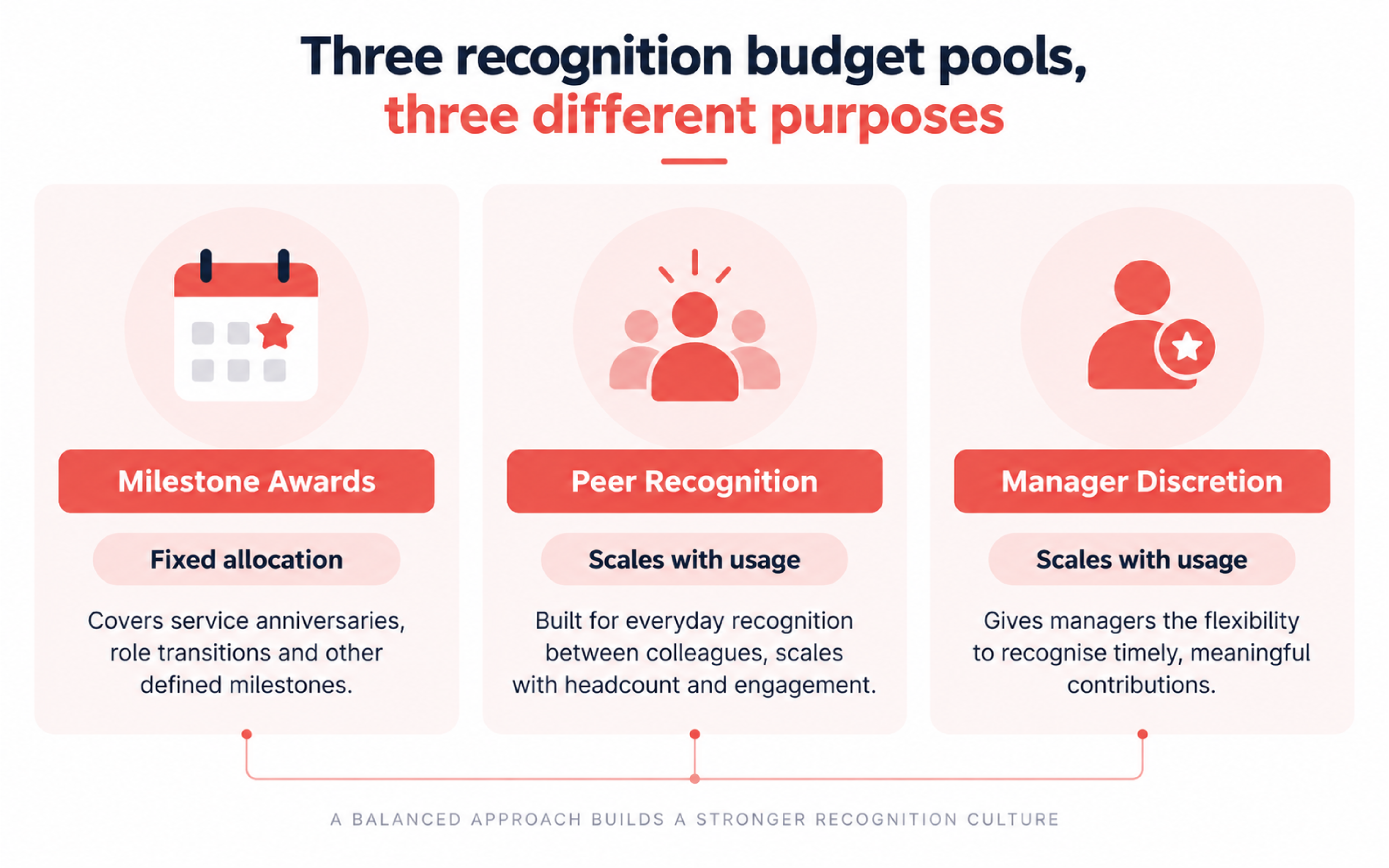
Once the total figure is set, most of the budgeting error HR leaders make sits in allocation rather than in the top-line number. SHRM's guidance treats milestone awards, peer-to-peer recognition and manager discretionary budget as three distinct pools, each with a different purpose and a different appropriate share of total spend. Milestone awards, covering service anniversaries and role transitions, tend to be predictable and should be budgeted as a fixed, non-discretionary line. Peer-to-peer recognition, by contrast, needs to scale with headcount and usage rather than being fixed, since Gallup's research associates strong peer recognition specifically with lower voluntary turnover. Manager discretionary budget is the pool most often under-allocated, despite evidence that timely, specific recognition from a direct manager has a disproportionate effect on day-to-day engagement compared with programme-wide awards.
A platform such as ApplaudIQ, built for employee recognition with native Slack and Microsoft Teams integration, gives HR leaders visibility across all three pools in one place, which matters because the biggest allocation failure is not choosing the wrong split but losing track of actual spend against each pool once the programme is live. Without that visibility, manager discretionary budget is the pool most likely to be underspent, quietly reducing the programme's effectiveness until the annual engagement survey results come back.
Building the Finance Case: How to Frame Recognition as Cost Avoidance Rather Than Discretionary Spend
Recognition budgets lose in the annual planning cycle when they are framed as a culture investment competing against revenue generating projects. They win when they are framed as cost avoidance against a number Finance already tracks, namely attrition. Gallup's research finds that employees who receive high-quality recognition, meeting at least four of Gallup's five pillars of strategic recognition, are 65 percent less likely to be actively looking for another role, and separately that well-recognised employees are 45 percent less likely to leave their organisation within two years. Set against Gallup's turnover cost figures of up to 200 percent of salary for a manager, even a modest reduction in voluntary attrition converts a six-figure recognition budget into a defensible retention reserve rather than a line item to be trimmed first.
The most effective version of this case is not a single slide of statistics but a worked calculation specific to the organisation, using its own attrition rate, its own average salary by role band and Gallup's published cost-of-turnover percentages. HR leaders who walk into the budget conversation with that calculation, rather than an industry benchmark alone, consistently report an easier path to approval, because the number is no longer abstract. Finance does not need to be persuaded that recognition matters. It needs to see the specific figure recognition spend is protecting against.
How to Phase Recognition Investment to Match Budget Availability Without Launching a Partial Programme
Organisations that cannot fund the full 1 percent benchmark in year one face a genuine risk, not from underfunding itself but from launching a visibly partial programme that damages credibility before it has a chance to prove value. The safer sequencing is to phase scope rather than phase quality. A first-year programme funded at 0.5 percent of payroll, built around service milestone awards and a functioning peer-to-peer layer, delivered well and communicated clearly, outperforms a first-year programme that attempts all three budget pools at once but funds each so thinly that employees notice the gaps.
A platform such as ApplaudIQ supports this phased approach directly, since milestone rewards, peer recognition and manager discretionary budget can be introduced in sequence rather than requiring the full feature set from day one, which lets HR leaders scale the programme as budget is proven rather than committing to the full spend before the first year's results are known. The second-year expansion should be tied explicitly to the KPIs set out below, so that budget increases are justified by measured engagement change rather than by the calendar alone.
Measuring Budget Efficiency: The KPIs That Show Whether Recognition Spend Is Converting to Engagement
A recognition budget that cannot be measured against outcomes will not survive a second annual review, however well the first year's spend was allocated. Four KPIs give HR leaders a defensible efficiency case. Participation rate, the share of eligible employees who have both given and received recognition within a set period, is the leading indicator, since Gallup's research consistently links low participation to low programme return regardless of total spend. Recognition frequency per employee tracks whether the programme is being used as a continuous behaviour or only around scheduled events. Engagement score movement, measured against the organisation's existing engagement survey rather than a vendor-specific score, ties recognition spend directly to the metric Finance already reviews. Voluntary attrition by team, cross-referenced against recognition participation at the team level, is the strongest evidence available that the programme is doing the retention work its budget was built to justify.
None of these KPIs require a new measurement system if the recognition platform already reports participation and frequency data natively, which is the case with ApplaudIQ. The efficiency case for next year's budget should lead with these four figures rather than with total spend, since a smaller, highly used programme will outperform a larger, poorly adopted one on every KPI that Finance actually reads.
Frequently Asked Questions
What percentage of payroll should a recognition programme budget be?
SHRM sets 1 percent of total annual payroll as the baseline for a well-functioning recognition programme, with a practitioner range of 0.5 percent to 2 percent depending on organisation size and recognition maturity. Research from Bersin and Associates links spend at or above that 1 percent threshold to a 79 percent higher rate of achieving stated business goals. HR leaders should use 1 percent as the figure to defend to Finance rather than the figure to start negotiations from.
How do HR leaders justify a recognition budget increase to Finance?
The strongest case frames recognition spend as cost avoidance against attrition rather than as discretionary culture spend. Gallup prices voluntary turnover at up to 200 percent of salary for a manager, 80 percent for a technical role and 40 percent for a frontline role, figures that convert a recognition budget into a retention reserve when set against an organisation's own attrition data. A worked calculation using the organisation's own salary bands is more persuasive than an industry benchmark alone.
Can a recognition programme be phased in rather than fully funded in year one?
Yes. Phasing scope, rather than launching every budget pool at a reduced level, protects programme credibility. A well-funded, narrower first-year programme built around service milestones and peer recognition typically performs better than a thinly funded programme covering all three budget pools at once. Platforms such as ApplaudIQ support this by allowing milestone awards, peer recognition and manager discretionary budget to be introduced in sequence as budget is proven.
When should HR leaders review recognition programme spend against results?
Recognition spend should be reviewed at least twice a year against participation rate, recognition frequency, engagement score movement and voluntary attrition by team, rather than only at the annual budget cycle. Reviewing these KPIs mid-year gives HR leaders the evidence needed to adjust allocation across milestone awards, peer recognition and manager discretion before the annual planning conversation begins.
Conclusion
A defensible recognition budget starts from SHRM's 1 percent baseline, is allocated deliberately across milestone awards, peer recognition and manager discretion, and is framed to Finance as cost avoidance against Gallup's published turnover figures rather than as discretionary spend. As recognition data becomes easier to tie directly to attrition and engagement metrics, the annual budget conversation is shifting from a culture pitch to a numbers conversation, one that favours HR leaders who arrive prepared.

See how ApplaudIQ gives HR leaders the participation and spend visibility that conversation depends on. Book a Demo
Sign up for our newsletter for trending top content!


