
How Employee Recognition Improves eNPS, and How to Prove It to Your Leadership Team

Sign up for our newsletter for trending top content!
Recognition improves employee Net Promoter Score because advocacy requires an employee to put their own reputation behind the organisation, and people do that for employers they believe notice their contribution. Proving it is a separate problem from causing it.
An employee recognition platform can produce the activity data required, but the case only holds if recognition data and survey data are reviewed together, at team level, across at least two cycles, and presented as a weight of evidence rather than as a claim of proof.
Most recognition business cases fail at the second part rather than the first.
What eNPS Measures, and Why Recognition Sits Close to It
eNPS asks one question, adapted from the Net Promoter methodology developed at Bain and Company: how likely is an employee to recommend the organisation as a place to work. Compressing sentiment into a single advocacy signal makes it easy to track and hard to diagnose, which is the trade-off every organisation using it accepts.
Recognition sits unusually close to that signal, and the reason is structural rather than sentimental. Recommending an employer is a reputational act. The employee is telling somebody they know that this is a good place to work, and if that turns out to be wrong the cost lands on them. People do not extend that guarantee to an organisation they feel invisible inside.
This is why recognition and eNPS tend to move together more closely than most other interventions in a people function. A pay review changes what an employee receives. Recognition changes what an employee believes about whether their contribution registers, and belief is what an advocacy question is measuring.
The Recognition to eNPS Chain, Stage by Stage
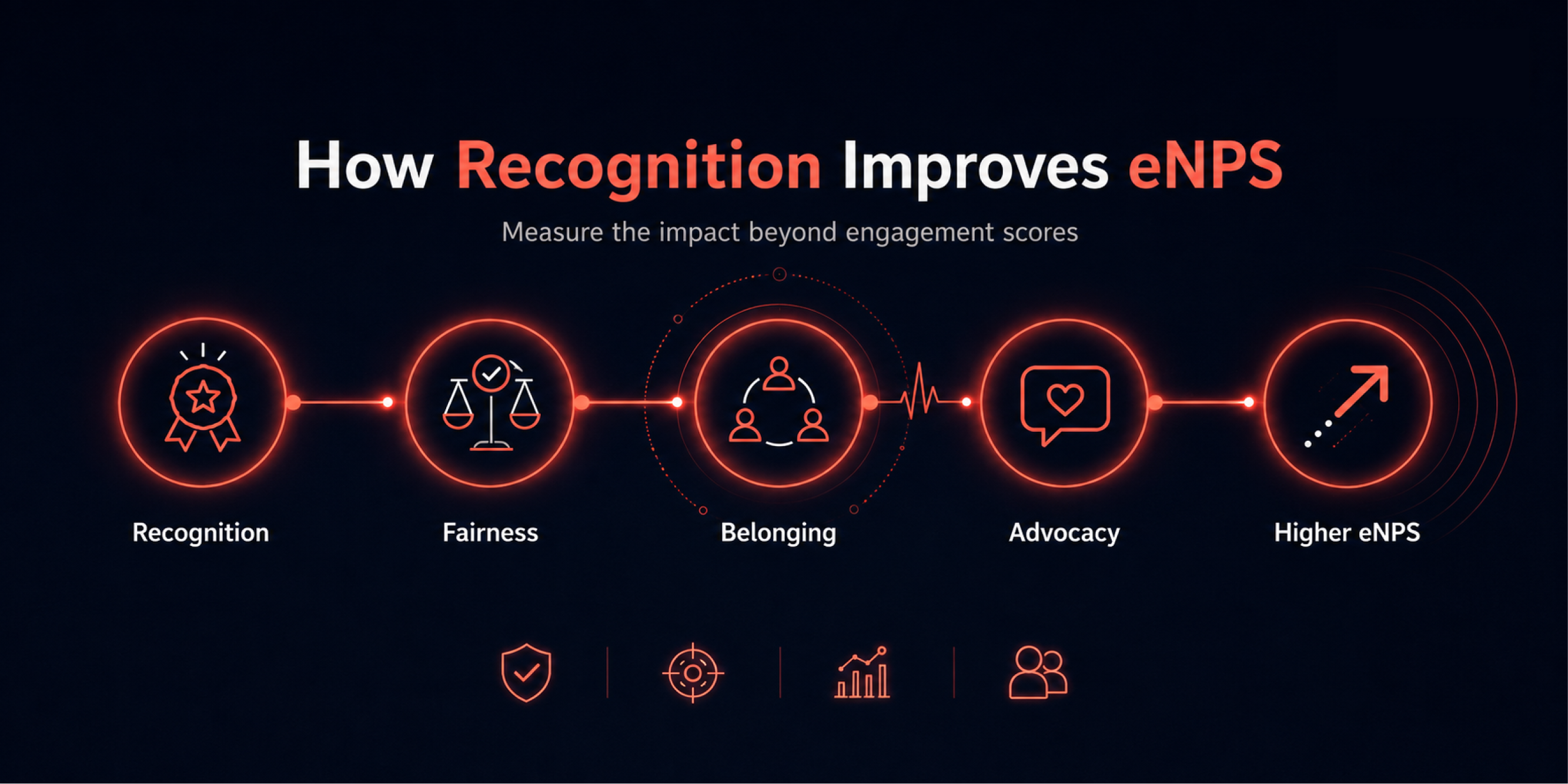
The relationship runs through three stages, and an HR leader presenting to a board should be able to name each rather than treat the connection as a black box.
Stage one, perceived fairness. Recognition that appears inconsistent or dependent on which manager an employee reports to damages trust rather than building it. An employee who watches a colleague acknowledged for work equivalent to their own, unacknowledged, draws a conclusion about the organisation rather than about the manager. Fairness has to hold before anything downstream can.
Stage two, belonging. Once recognition is credible, it establishes that an individual's contribution is visible to people beyond their immediate manager. That visibility is what converts employment into membership, and membership is the precondition for advocacy.
Stage three, durability. Recognition delivered close to the moment of achievement establishes a link the employee can feel. Recognition batched into an annual cycle asks them to reconstruct which contribution is being acknowledged, and a reward whose cause is unclear reads as an entitlement rather than an acknowledgement.
ApplaudIQ is an employee recognition and rewards platform from The Reward Store, with native Slack and Microsoft Teams integration, which places recognition close to the moment it is earned rather than batching it into a later cycle.
The third stage is where most programmes lose the effect they built in the first two. An organisation can be scrupulously fair and comprehensively visible and still deliver recognition so late that the causal link has dissolved.
Building a Measurement Cycle That Can Withstand Scrutiny
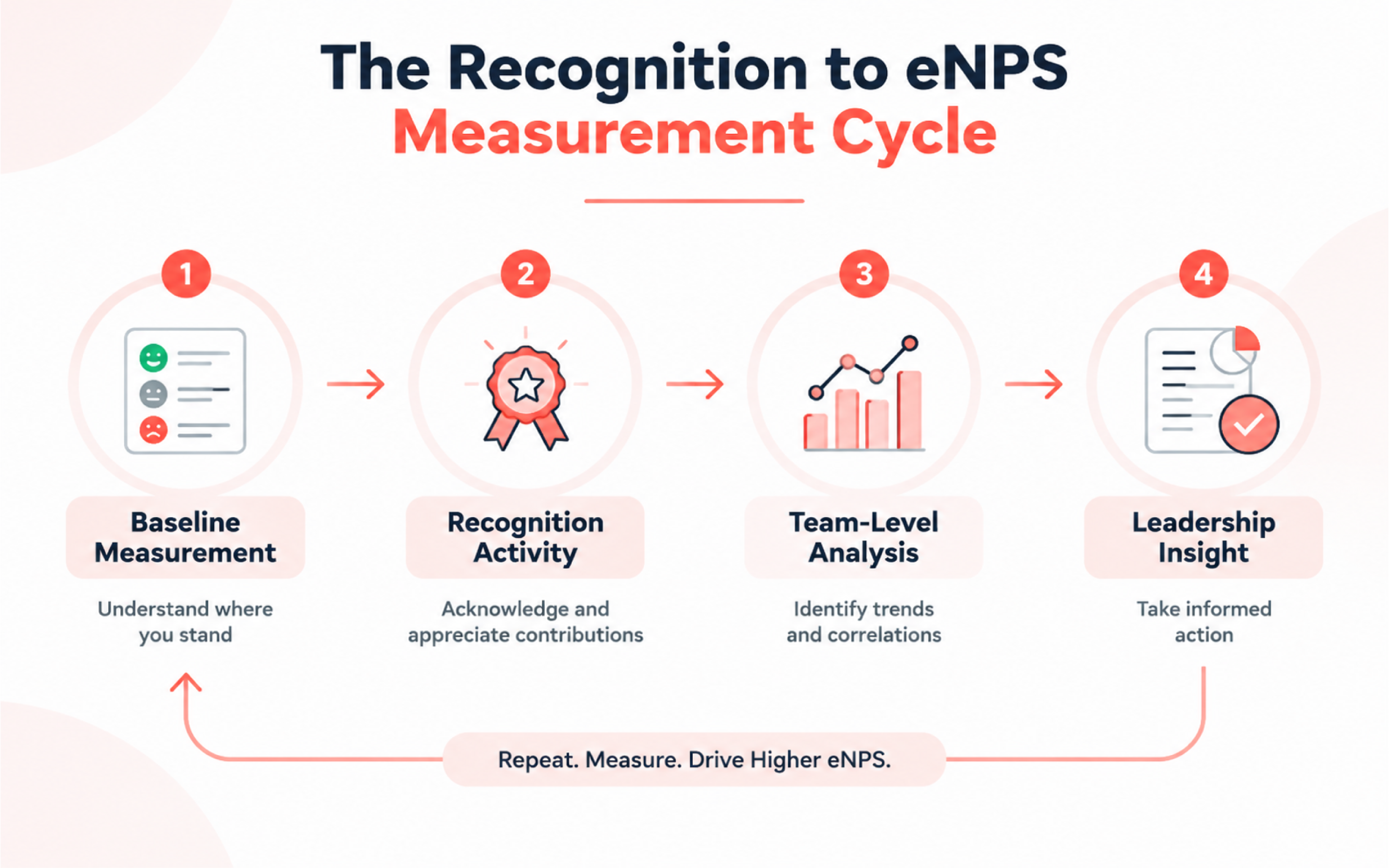
A single annual pulse cannot attribute movement to anything. By the time twelve months have passed, a pay review, a leadership change, a reorganisation and a recognition programme have all happened, and the survey cannot separate them.
The activity data in the third row comes from the reporting layer of an employee recognition platform, and is the component most often missing, and the most common structural failure is that recognition data and survey data are held by different people, reviewed in different meetings, and reported separately. An organisation in that position cannot demonstrate a relationship between them regardless of how strong the relationship actually is.
Segmenting the baseline by team is what makes everything else possible, and it is the step most frequently skipped because it takes an afternoon and produces nothing immediately useful.
Isolating the Recognition Variable
The hardest question a board asks is whether the movement is really recognition, or a pay review, a leadership change, or simply the season. The honest answer is that no people function isolates a single variable to laboratory standard, and claiming otherwise is the fastest way to lose a sceptical finance audience.
Three approaches build a defensible case.
Staggered rollout comparison. Where recognition activity reaches some teams before others, comparing eNPS movement between earlier and later teams over the same period provides a natural control. This is the strongest evidence available to most organisations and it requires deciding not to launch everywhere at once, which is a decision that has to be made before the programme starts rather than after.
Timing correlation at team level. Plotting recognition volume against eNPS by quarter, per team, shows whether the two genuinely move together or merely both trend upward. Two rising lines are not evidence. Two lines that rise together in the teams where activity rose, and stay flat where it did not, are.
Open text triangulation. Pairing the quantitative movement with free text survey responses matters because employees name recognition directly when asked what changed. A quoted employee sentence does more with an executive audience than a correlation coefficient, and it costs nothing to collect.
State the limits of the claim explicitly when presenting. A board that hears a measured claim tends to accept it. A board that hears an overstated one starts testing everything else in the pack.
Framing Recognition Investment for a Board
Boards respond to cost and risk more readily than to engagement language, and the translation is straightforward once the data exists.
Attrition cost per role is a figure most finance functions already calculate, covering recruitment, onboarding and lost productivity during the vacancy and the ramp. It is their number, not yours, which is precisely what makes it useful. Presenting recognition investment against a cost the finance function itself maintains removes the argument about whether the comparison is fair.
A presentation that lands generally covers four things in this order: the baseline and its trend, the recognition investment made, the correlated movement in eNPS and retention across the same period, and the cost avoided expressed against the organisation's own attrition cost per role. Framing the spend as risk mitigation rather than as a wellbeing initiative tends to secure continuing budget more reliably.
When recognition is not the eNPS problem
There are cases where this analysis will mislead. Where eNPS is depressed by compensation sitting below market, by a specific leadership problem, or by job insecurity following a restructure, recognition will not move it and a recognition programme presented as the remedy will fail visibly. Free text responses usually identify which situation applies within one cycle, and reading them before designing an intervention costs nothing. Recognition is a strong lever on advocacy when the fundamentals are sound. It is not a substitute for fixing a fundamental that is not.
Why Sector Benchmarks Are Less Useful Than Your Own Baseline
HR leaders routinely ask what a good eNPS looks like for their sector, and the question is less useful than it appears.
Published benchmark ranges are difficult to compare because the inputs differ in ways the headline number conceals. Survey methodology varies. Question wording varies, and eNPS is unusually sensitive to wording. Response rates vary, and a low response rate skews towards the engaged and the very disengaged. Sector definitions vary. Two organisations reporting the same figure may have measured materially different things.
The consequence is that a benchmark can mislead in both directions. An organisation above its stated sector range may conclude it has no problem while a specific team carries a serious one. An organisation below it may spend against a gap that is a methodology artefact.
The more defensible reference points are internal. Your own trend across consistent quarterly cycles, measured with unchanged wording. Variation between teams inside the same organisation, which uses one methodology throughout and is therefore genuinely comparable. And the gap between your highest and lowest scoring teams, which is usually more actionable than any external figure, because it identifies where to look rather than how to feel.
If an external benchmark is used at all, cite the specific study and its methodology alongside the number, and treat a figure without a traceable source as unusable rather than as directional.
Where ApplaudIQ Fits
ApplaudIQ covers peer to peer recognition, manager led awards and milestone celebrations in one platform, with monetary and non monetary reward options attached to recognition.
Its programme reporting is what produces the recognition activity data a measurement cycle requires, including volume, spread across teams, and time from qualifying event to recognition.
Frequently Asked Questions
What is a good eNPS score?
There is no universal figure, because ranges differ by sector and, more importantly, by survey methodology, question wording and response rate. A more defensible reference is your own trend across consistent quarterly cycles with unchanged wording, together with the variation between teams inside your own organisation, which is measured on one methodology and therefore genuinely comparable.
How quickly does recognition affect eNPS?
Early movement is often visible within one or two quarterly cycles, particularly where recognition was previously inconsistent or absent, since the easiest gap to close is the absence of anything structured. Larger and more durable movement builds over a longer period. A single cycle is not evidence of either, which is why two cycles is the minimum before presenting.
Can peer to peer recognition move eNPS as effectively as manager led recognition?
Peer recognition contributes strongly because it broadens the source of acknowledgement beyond a single reporting relationship, which matters for the belonging stage of the chain. Manager recognition carries different weight because it comes from the person who decides progression. A programme running both captures a wider signal than either alone.
What is an employee recognition platform and what does ApplaudIQ do?
An employee recognition platform is software for acknowledging specific contributions, attaching rewards and keeping a record of recognition. ApplaudIQ is an employee recognition and rewards platform from The Reward Store, covering peer to peer recognition, manager led awards and milestone celebrations, with monetary and non monetary reward options and reporting for HR teams. It integrates natively with Slack and Microsoft Teams.
Our engagement survey shows high recognition scores but eNPS is not moving. Why?
Usually because recognition is happening but is not timely, visible beyond the immediate manager, or consistently applied across teams. Reviewing time from qualifying event to recognition, and the spread of recognition across teams, alongside the survey rather than the survey alone, generally locates the disconnect within one cycle.
How do you prove recognition caused the eNPS movement?
You do not prove it, you build a weight of evidence. A staggered rollout comparison between earlier and later teams is the strongest instrument most organisations have. Timing correlation at team level and open text responses naming recognition directly support it. State the limits of the claim to a board rather than overstating them.
When should recognition return be taken to the board?
Once at least two quarterly cycles of correlated data exist. A single data point offers nothing defensible, and presenting one invites a challenge that is difficult to answer. Present the trend rather than an isolated figure, and bring the recognition activity data alongside the survey data rather than in a separate paper.
What is the most common reason a recognition business case fails?
Recognition data and survey data held by different people, reviewed in separate meetings and reported separately. An organisation in that position cannot demonstrate a relationship between them however strong the relationship actually is. The fix is a single quarterly review containing both, which is an organisational change rather than a technical one.
.png)
To see how recognition activity data can sit alongside your engagement measurement, Book a Demo.
Sign up for our newsletter for trending top content!


