
Diwali Rewards Across Cities: How to Give Employees in Different Locations Equal Festive Value

Sign up for our newsletter for trending top content!
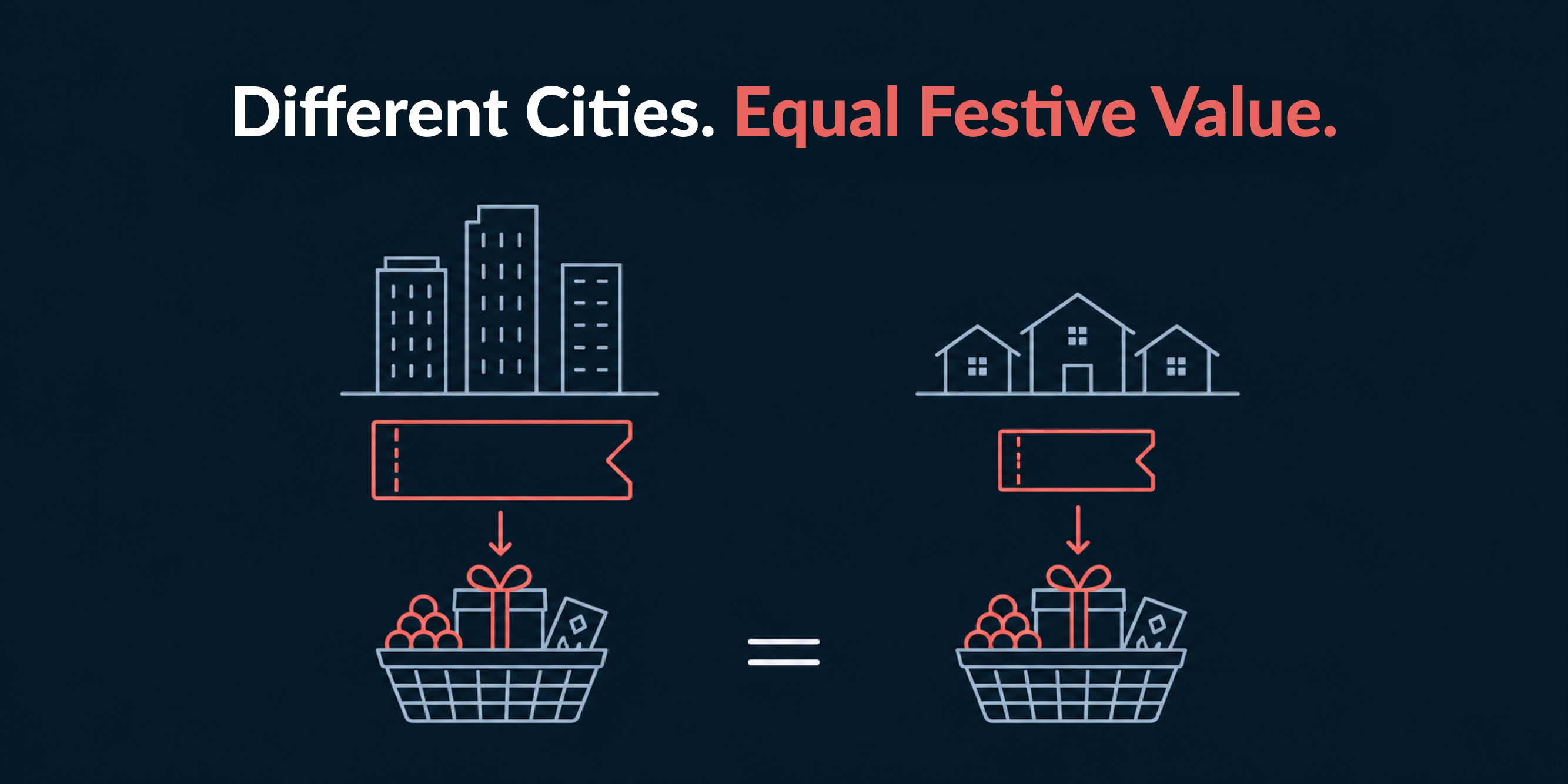
Equal festive value comes from setting one base reward value for the organisation and scaling it by location with a cost of living index, which is a published measure that compares what a standard set of goods and services costs in one place against a reference place.
Diwali rewards for employees in different cities feel equal only when each amount carries the same purchasing power locally, because an identical rupee figure buys less in Mumbai than in Indore or a smaller town. The adjustment is fair when it is rules based, published before the amounts, and limited to gifts whose purpose is festive parity, and it is unfair when it is applied silently or to rewards that recognise individual contribution.
Why Equal Diwali Rewards Can Feel Unequal
An identical rupee amount feels unequal because employees judge a reward by what it buys in their own city, not by the figure on the payroll file.
Purchasing power is local
Purchasing power is the quantity of goods and services that a fixed sum of money can buy in a given place. Festive spending is concentrated in categories that are priced locally: food for guests, clothing, home decoration, local transport and gifts for family. When these cost more in one city, the same voucher covers a smaller share of the festive basket there, and an employee in that city reasonably reads the reward as smaller. The reward has not changed, but the cost of the basket it must cover has.
Where the festival is spent decides the real value
A diagnostic question catches a problem that a city table alone misses: where is this reward actually spent? An employee who works in Mumbai but travels to a hometown for Diwali spends in the hometown, and an employee in a smaller town who buys gifts online spends at national prices. Adjustment by office address assumes that people spend where they work. For a festival built around travelling home, that assumption is weaker than it is for a monthly allowance.
Why the complaint rarely reaches HR
Dissatisfaction tends to appear as informal comparison in team chats rather than as a formal grievance, because employees in a dearer city assume that HR has already considered the difference. HR therefore often learns of the problem only after the festival, when the reward can no longer be corrected.
Table 1: Questions to ask of any cost of living index
What a Cost of Living Index Does to Reward Value
A cost of living index scales a single base reward into a location specific amount in proportion to relative local prices, so that the amount carries equivalent purchasing power wherever the employee sits.
How the scaling works
The base value is stated for a reference location. Every other location is compared with the reference through the index, so that locations with higher prices receive a larger amount and locations with lower prices receive a smaller one. Choose as the reference the location where most employees sit, not the head office city by default. A reference set at the dearest city lowers every other amount, and one set at the cheapest raises them, so the choice shapes the message of the whole programme.
What to check before trusting an index
The result depends on the basket of goods behind the index. An index weighted heavily towards housing will overstate the adjustment for a reward spent on festive goods, because rent differences between cities are larger than differences in the price of sweets or clothing. Table 1 sets out the questions to ask.
An index describes a place, not a person
An index averages prices across a city, so an employee with unusual costs, such as a long commute or a dependent family living elsewhere, is not captured. Treat the output as a defensible starting point and keep an exception route for documented cases.
Setting a Base Value Once and Adjusting by Location
Set the base value from the approved budget and the intent of the gift, apply the index to each location, then round and floor the results, so that one decision produces every amount.
The sequence and its trade off
A base value is the single reward amount, stated for the reference location, from which every location specific amount is derived. Decide first whether the total envelope or the base value is fixed. If the base value is fixed, total spend moves with the mix of locations, and Finance must approve the variance.
If the envelope is fixed, the base value floats to fit it, and every amount may change if headcount changes before payment. Then round each result to denominations that exist in practice, and set a floor so that no location receives an amount that looks token.
A worked scenario
Consider a professional services firm with offices in Mumbai, Indore and a smaller town delivery centre. Indore holds the largest headcount, so the HR Director uses it as the reference location. The index places Mumbai above Indore and the delivery centre below it. The Head of Total Rewards applies the index to the base value, rounds each result to available voucher denominations, and sets a floor for the delivery centre.
The Finance partner then observes that total spend is no longer headcount multiplied by the base value, because the mix of locations shifts it. The firm decides to hold the total envelope fixed and let the base value float to meet it, since the budget was approved before the method was chosen. The Mumbai team receives a larger voucher, the delivery centre a smaller one, and all three can buy a comparable festive basket.
Keeping the table current
Manual adjustment tends to fail at maintenance, because each employee’s location changes through joiners, leavers and transfers while the index table stays fixed in a spreadsheet. Whether the calculation lives in a spreadsheet or in an employee recognition platform, the discipline is the same: one base value, one table and one named owner.
As one concrete illustration, ApplaudIQ is an employee recognition and rewards platform from The Reward Store. It applies a cost of living index to rewards and benefits, so that HR sets a base value once and each location receives an equivalent value, and it synchronises employee data with the HRMS in real time, so joiners and leavers flow in automatically.
When Location Adjustment Feels Unfair, and How to Avoid That
Adjustment feels fair when it equalises a festive experience that employees understand, and unfair when it appears to price people by where they live or alters recognition of their contribution.
Where adjustment is fair, and where it is not
Table 2 separates the situations by purpose, because the purpose, not the mechanism, decides whether employees accept the difference.
Table 2: Whether to adjust by location
The situation where adjustment is the wrong choice
If the index gaps between your offices are small, if each location has few employees, or if the gift is symbolic, give a single flat value. The mechanism is simple: the explanation required by an adjustment costs more goodwill than the small difference in purchasing power it corrects.
The counter argument for a flat amount
A flat amount has a genuine case. It is visible, it is easy to explain, and it signals that every employee is held in equal regard, which some employees value above purchasing power. An index also carries error, and a wrong adjustment is harder to defend than a flat figure. Both positions are sound. Adjustment is preferable where cost differences are large and the gift is meant to fund a festive basket, and a flat amount is preferable where the gift is meant as a symbol.
A control that catches the common failure
Employees in lower cost locations may read a smaller number as a lower valuation. The control is to present the reward as equivalent purchasing power, to state the method alongside the amount, and, where the reward is a choice among options, to let employees spend it on what they value, so that the headline figure matters less.
Communicating Adjusted Rewards to Employees
Communicate the method before the amounts, brief managers before employees, and place the explanation where employees already look for reward information.
The order of messages
Publish the principle first: the reward is designed to carry equal festive value in every location, and amounts differ because local prices differ. Then publish the method, naming the index source and the reference location. Amounts follow last. If the amounts arrive first, the explanation reads as a defence. The internal communications lead should draft the message, and the Head of Total Rewards should approve the wording of the method.
Preparing managers for the first question
The first question will be why a colleague in another city receives a different amount. Give managers a one sentence answer and a short document, so that they do not improvise. Where an employee recognition platform already carries recognition and points, place the explanation there as well, because employees read it in the place where they receive the reward.
What not to say
Do not describe the adjustment as cost saving, even where it reduces spend in some locations, and do not promise that amounts will be identical in future years, because the index will change.
A Location Fair Diwali Reward Framework
Follow these steps in order, and record the decision at each one.
- State the intent in one sentence. Decide whether the gift aims at equal purchasing power or at equal symbolism, because the answer determines whether to adjust at all.
- Confirm the scope. Exclude the statutory bonus under the Payment of Bonus Act, 1965, and confirm with payroll how vouchers and gifts are treated as perquisites under the Income Tax Act, 1961.
- Choose the reference location and the index. Record the publisher, the basket, the date and the reason for the reference location.
- Agree the budget with Finance. Decide whether the base value or the total envelope is fixed, and approve the permitted variance.
- Assign each employee to one location. Use a single field in the HRMS or the employee recognition platform, and write a rule for relocated and remote employees.
- Calculate, round and floor. Apply the index, round to usable denominations, set the floor, and have the Head of Total Rewards review exceptions.
- Publish the method, then the amounts. Brief managers first, and give them the one sentence answer.
- Review after the festival. Collect questions and comments, record what the index missed, and revise the table before the next cycle.
Where ApplaudIQ Fits
An employee recognition platform fits at the point where a base value, a location rule and a budget must be applied consistently across many employees. ApplaudIQ, from The Reward Store, applies a cost of living index to rewards and benefits, so HR sets a base value once and each location receives an equivalent value.
It allocates budgets by team, country or programme, tracks spend as it is given, and lets managers recognise within limits that HR and Finance set. Recognition and points can be sent from Slack, Microsoft Teams and Google Chat. Reports show points sent, rewards redeemed, and budget against spend. It does not issue gift cards, run consumer loyalty programmes or run channel incentive programmes. The decisions on intent, index choice and fairness remain with HR and Finance.
Frequently Asked Questions
How does ApplaudIQ adjust reward value by location?
ApplaudIQ applies a cost of living index to rewards and benefits. HR sets a base value once, and each location receives an equivalent value. Budgets can be allocated by team, country or programme, and managers recognise within limits that HR and Finance set. Spend is tracked as it is given, and reports show budget against spend by team, country or programme.
How do I give employees in Mumbai and a smaller town the same Diwali gift value?
Set one base value for a reference location, then scale it for each office using a published cost of living index, so that each employee receives equivalent purchasing power rather than an identical rupee amount. Record the index source, round to usable denominations, and publish the method before the amounts. If the index differences between your offices are small, a single flat value is simpler and usually preferable.
What is a cost of living index in employee rewards?
A cost of living index is a measure that compares what a standard set of goods and services costs in one place against a reference place. In rewards, it scales a base amount so that employees in dearer cities receive more and employees in cheaper cities receive less, with the aim of equal purchasing power. Its result depends on the goods included in the basket.
Is it fair to give employees in cheaper cities a lower Diwali reward?
It is fair when the purpose is equal purchasing power, the method is published and the same rule applies to everyone. It is not fair when the adjustment is applied silently, when it is applied to rewards that recognise individual performance, or when the index gap is so small that the difference is noise. In those cases, a single flat value is the better choice.
Should a statutory Diwali bonus differ by city?
The statutory bonus under the Payment of Bonus Act, 1965 is determined by the Act and by each employee’s eligibility and wages, not by a discretionary city adjustment. A festive reward is a separate, discretionary gift. Do not use location adjustment to alter statutory entitlements, and confirm the position for your establishment with legal counsel or your payroll adviser.
Do festive gifts and vouchers attract tax for employees in India?
Under the Income Tax Act, 1961 and its rules, gifts and vouchers from an employer are generally treated as perquisites once they exceed a prescribed annual threshold, and cash gifts are treated as salary. Location adjustment can push an employee in a dearer city across the threshold, so check the current limit with payroll and your tax adviser before finalising amounts.
When is a flat Diwali reward better than a location adjusted one?
A flat reward is better when index differences between offices are small, when each location has few employees, when the gift is symbolic rather than financial, or when the reward recognises individual performance. In these cases the administrative effort and the risk of employees reading the difference as unequal regard outweigh the gain in purchasing power equivalence.
How early should HR announce location adjusted Diwali rewards?
Announce the method once the budget is approved and well before distribution, so that employees receive the explanation before they see any amount. Comparisons between colleagues begin as soon as numbers are visible, and an explanation that arrives after the amounts is read as a defence. Brief managers first, because they receive the first questions.
Sign up for our newsletter for trending top content!


