
Diwali Recognition for Field and Frontline Teams: Reaching Employees Who Are Not at a Desk

Sign up for our newsletter for trending top content!
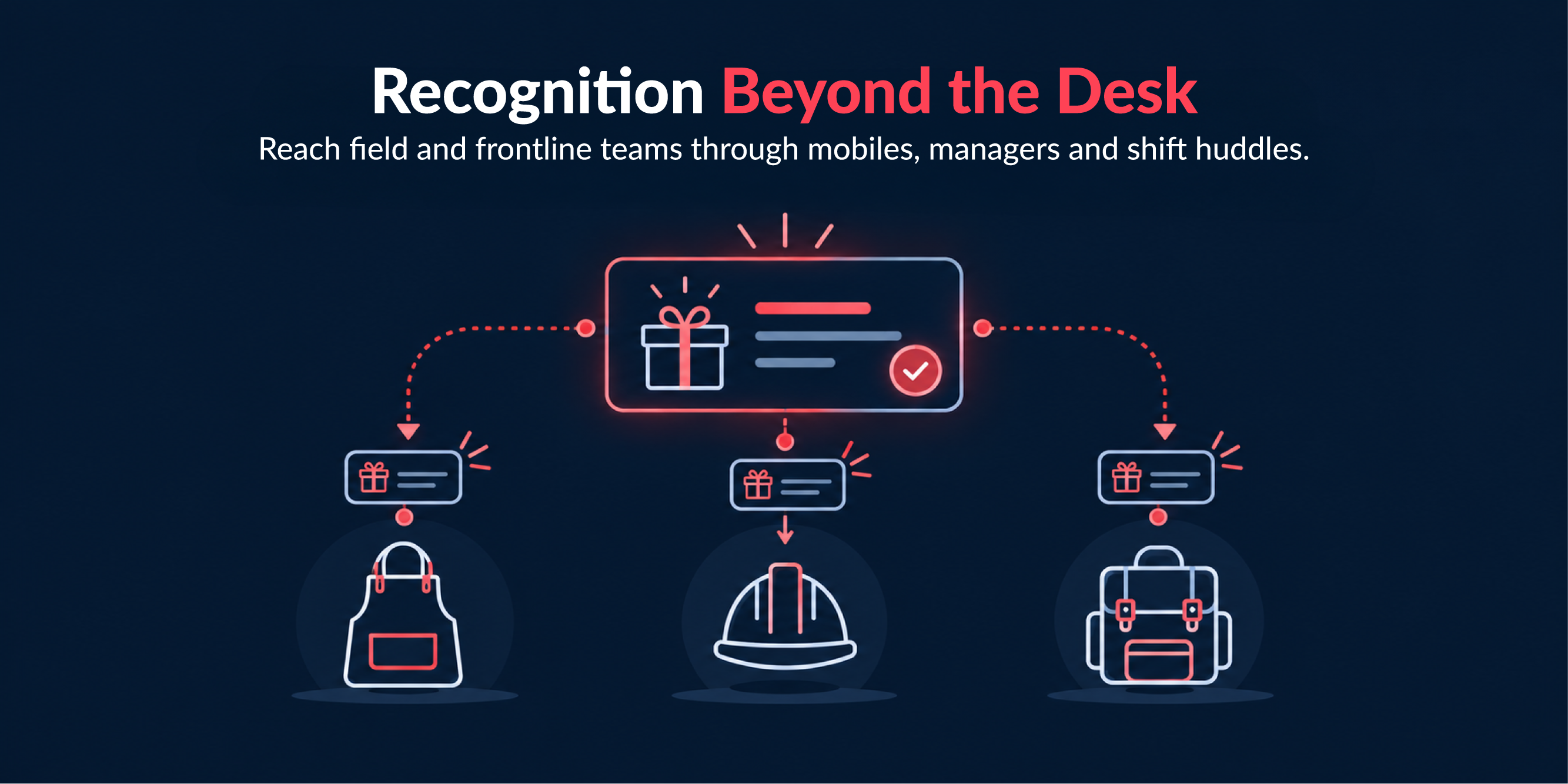
Diwali recognition for frontline employees works when it reaches people through channels they already use during a shift, such as a personal phone message, a supervisor in a shift huddle or a printed notice, rather than through desk tools such as the intranet or a chat application. It also works only when store managers, plant supervisors and area sales managers hold their own budget, so that they can act before the festival without waiting for head office. Digital recognition covers most of that reach, and an in person moment covers the rest.
Why Frontline Teams Are Missed in Festive Recognition
Frontline teams are missed because festive recognition is planned, approved and announced through channels these employees do not open at work. A frontline employee is a worker who performs the job at a store counter, on a production line or along a customer route and has no dedicated desk or company laptop. An employee recognition platform is a software system that records, funds and announces recognition, and one built around chat integrations reaches only people who hold chat accounts.
The channel gap
HR and internal communications design programmes at desks, so announcements go to corporate email, the intranet and chat. A store associate with no company email address never sees them, and a machine operator barred from carrying a phone onto the floor sees them, if at all, after the festival. Nobody decides to exclude these employees; the exclusion is the sum of defaults that suit desk workers.
The authority gap
The second cause is who holds the money. When the budget sits with a regional HR head, the manager who witnesses good work cannot act, and a request travelling up with an approval travelling back will not finish before the festival.
A diagnostic question and a counter argument
Ask this first: if a cashier at your busiest store opened no company system this week, how would that person learn that recognition exists, and who could give it? Some HR leaders argue that frontline employees value the statutory bonus above recognition and that extra messaging is noise. That argument has substance. The bonus under the Payment of Bonus Act 1965 and its successor provisions in the Code on Wages 2019, where it applies, is an entitlement and must never be presented as discretionary recognition or replaced by it.
Reaching Employees Who Do Not Use Chat Tools All Day
Reach them through the channel each role already opens for its own reasons, and treat Slack, Microsoft Teams or Google Chat as one channel that serves only employees who hold an account. The table matches common frontline roles to the channel most likely to be read and the failure to expect.
Identity and contact data
The first obstacle is data, not messaging. An employee who has no working personal mobile number or email address in the HRMS cannot be reached at all, whichever employee recognition platform is used. Collect missing details with a stated purpose and consent, because the Digital Personal Data Protection Act 2023 expects personal data to be used only for the purpose for which it was collected. Contract and agency workers are the group most often missing from the record.
Timing against shifts and routes
A message sent mid morning to a retail associate on the shop floor is read at the next break at best, and a message sent in peak trading week competes with the rush. Send the explanatory message at least a week before the festival, and time later messages to shift end rather than head office hours.
Notifications, Reminders and Custom Emails
A frontline programme needs all three message types in a deliberate order, because each does a job the others cannot. A notification is a message that tells an employee an event has occurred, such as points having been sent. A reminder is a repeat message that prompts action after the first one was missed. A custom email is a message written by HR in its own words that carries the context a notification cannot.
Why the first message must come from HR
A notification from an unfamiliar sender is treated as spam by someone who has never used the system. A custom email in the local language, naming the manager who will recognise them and explaining in two sentences how recognition is received and used, establishes that the later notification is genuine. Send it before the first recognition is given.
Sequencing and suppression
The sequence is explanation, then notification when recognition lands, then a reminder before the festive window closes. The known failure is sending the reminder to everyone. Reminders that reach people who have already acted teach employees to ignore the next one, so wherever an employee recognition platform allows it, suppress them for completed actions.
Some HR teams worry that three messages is too many for employees who dislike contact outside work. Where employees have not agreed to messages on personal devices, use the supervisor channel instead and do not message personal numbers.
Giving Frontline Managers a Budget to Recognise
Give store managers, plant supervisors and area sales managers a defined budget they may spend without approval for each item, because recognition that waits for head office arrives after the moment has passed. A recognition budget is a sum that HR or Finance allocates to a manager to spend on recognising team members within stated limits.
Controls that catch known problems
Three controls address the usual failures. Set a limit per recognition and per manager, so that one enthusiastic manager cannot exhaust the pool. Allocate by frontline headcount rather than seniority, because budgets drift towards desk based managers who ask for them. Review distribution by site, role and manager after the festival, since favouritism and neglected teams show in the pattern of who received recognition rather than in any single instance.
A concrete illustration
ApplaudIQ is an employee recognition and rewards platform from The Reward Store. It allocates budgets by team, country or programme, lets managers recognise within limits that HR and Finance set, and tracks spend as it is given. That is one example of how an employee recognition platform can hold these controls in one place, so that they do not depend on a spreadsheet.
When this approach is the wrong choice
Manager budgets are the wrong choice at a site where managers have had no guidance on fair distribution or where earlier discretionary awards were seen as favouritism. Run a central programme with written criteria applied by HR instead, such as length of service, and introduce manager discretion later at a single pilot site. Confirm with payroll and Finance how gifts and vouchers are taxed before any budget is released.
Where Digital Recognition Needs an In Person Moment
Digital recognition is the wrong primary channel where employees cannot use a personal device during or around work, where trust in written messages is low, or where the value of recognition lies in being seen by colleagues. In those settings give the recognition in person and record it in the employee recognition platform afterwards.
Why the in person moment cannot be dropped
Points and messages are private, while a frontline team forms its sense of being valued in front of colleagues, at the shift huddle, the plant gate or the depot. A shift huddle is a short briefing at the start or end of a shift in which a supervisor passes on instructions and, here, names a contribution. A named acknowledgement from the plant head carries meaning a notification does not, and the digital record keeps budgets and reports accurate.
A worked scenario
Consider a regional retail chain with stores in three states and one central warehouse. Head office announced Diwali recognition through the intranet and chat, and the HR business partner learned on the third day that store associates had not seen it and warehouse operators were not permitted phones on the floor.
The corrective steps were to collect personal contact details through store managers with consent, send a custom email in Hindi and Kannada explaining the programme, release budgets to store managers and warehouse supervisors, and hold a short acknowledgement at each shift change. Managers then recorded each recognition so that Finance could see spend and HR could see which stores had been missed. The order mattered, because contact data came first and nothing else could reach anyone without it.
A Frontline Diwali Recognition Checklist
Work through these eight steps in order, because each one depends on the step before it.
- Audit reach. List every hourly, shift and field role from the HRMS and mark which employees have no company login, email address or desk.
- Confirm contact data. Collect personal mobile numbers or email addresses with consent and a stated purpose, as the Digital Personal Data Protection Act 2023 expects.
- Separate the bonus from recognition. State plainly in all communication that the statutory bonus, where it applies, is unaffected.
- Set manager budgets. Agree amounts and per recognition limits with Finance, allocate by frontline headcount and confirm tax treatment with payroll.
- Write the first message. Draft a custom email in each local language that frontline teams use, and have a supervisor read it for tone before it is sent.
- Schedule notifications and reminders. Time them to shift ends and avoid peak trading days.
- Plan the in person moment. Name who will deliver it at each site and when, and tell managers to record it afterwards.
- Review distribution. After the festival, compare recognition by site, role and manager, and correct any gaps in the following quarter.
Where ApplaudIQ Fits
An employee recognition platform is the system that holds the rules, budgets and records behind the steps above. ApplaudIQ, offered by The Reward Store, supports peer to peer recognition, manager awards, award programmes and milestone moments, shown on a company wide activity wall. Recognition and points can be sent from inside Slack, Microsoft Teams and Google Chat.
Employees redeem points for rewards of their choice, and HR can write custom emails and send reminder notifications when points are sent. Budgets are allocated by team, country or programme, and spend is tracked as it is given. A cost of living index lets HR set a base value once so that each location receives an equivalent value. Employee data syncs with the HRMS in real time, and SAML single sign on gives one login across every country.
Frequently Asked Questions
How do I recognise frontline employees at Diwali when they have no company email address?
Use a personal mobile number or personal email address collected with consent and a stated purpose, and add it to the HRMS record. Where that is not possible, route recognition through the shift supervisor or store manager, who can announce it in the shift huddle and give a printed note. Record each instance afterwards so that budgets and fairness checks remain accurate.
Is Diwali recognition the same as the statutory Diwali bonus?
No. The statutory bonus is an entitlement under wage law, namely the Payment of Bonus Act 1965 and its successor provisions in the Code on Wages 2019, where it applies to the employee. Recognition is discretionary and names a person and a contribution. Communicate the two separately, and never present recognition as a replacement for a bonus that is legally due.
Can a store manager give Diwali recognition without head office approval?
Yes, within a budget and limits that HR and Finance have set in advance. The manager needs a defined amount, a limit per recognition and a clear record of what was given. Where managers have had no guidance on fair distribution, or earlier awards were seen as favouritism, use central criteria applied by HR first and introduce manager discretion later.
What is the best time to send Diwali recognition messages to shift workers?
Send the explanatory message at least a week before the festival, and time later messages to the end of the shift rather than to head office working hours. Retail associates are busiest during trading hours, and factory operators often cannot use a phone on the floor, so a message sent mid shift is usually read at the next break or after the shift.
How do I recognise factory workers who are not allowed phones on the production floor?
Give the recognition in person at shift change, delivered by the supervisor or plant head, and send any digital message timed for after the shift. Use a plant notice board or printed card for visibility. Then have the supervisor record the recognition so that points, budgets and reports stay accurate. The in person moment carries the meaning; the record carries the accountability.
How are employees told when ApplaudIQ points have been sent?
ApplaudIQ sends a reminder notification to the employee when points are sent. HR can also write custom emails. Recognition and points sent from inside Slack, Microsoft Teams or Google Chat appear on the same company wide activity wall. Employees then redeem the points for rewards of their choice.
Sign up for our newsletter for trending top content!


