
Diwali Gift Card Campaigns for Retailers: Planning Issuance, Formats and Budgets

Sign up for our newsletter for trending top content!
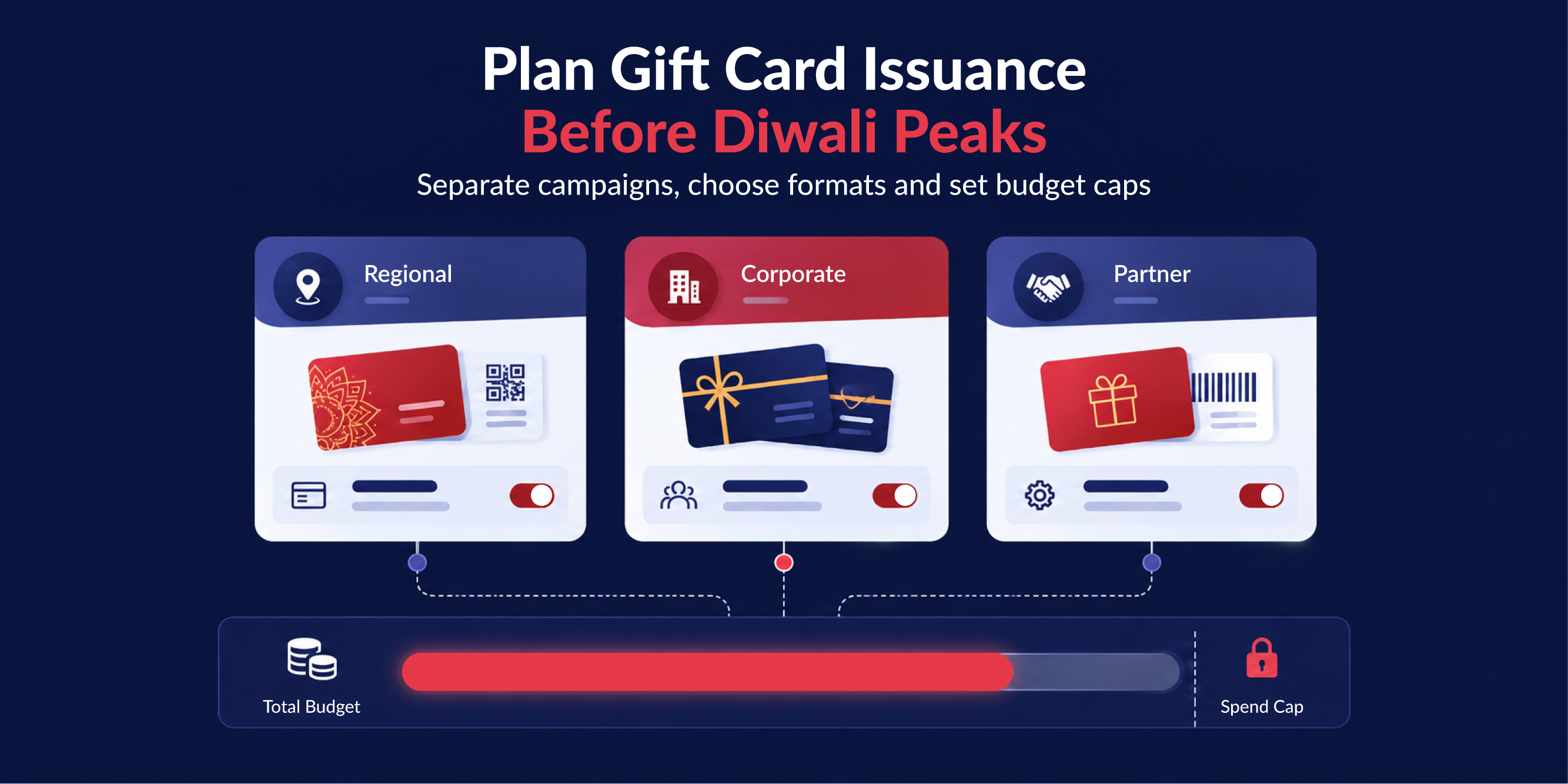
A retailer planning a Diwali gift card campaign should settle four decisions before the festive calendar is locked: which card formats to offer, which separate campaigns will serve regions, corporate buyers and partners, what fixed spending limit each campaign carries, and who may extend that limit. Marketing and finance should make these decisions together, because every card issued is a commitment that the retailer must honour at the till and account for later.
Why Diwali Gift Card Issuance Needs Its Own Plan
Diwali gift card issuance needs its own plan because demand arrives in a short window, from several kinds of buyer, under different rules, and a poor decision cannot be corrected mid peak without cost. Gift card issuance is the creation and activation of a stored value card or code that a recipient can later spend with the retailer.
Why year round defaults fail at peak
The main campaign usually fixes creative, dates and offer mechanics first. Issuance then inherits whatever the gift card issuance platform or point of sale was configured to do all year, which typically means one validity period, one denomination ladder and one shared budget line. At peak this fails for a specific reason: a shared pool cannot tell a corporate bulk order from a shopper’s purchase, so whichever demand arrives first consumes the allocation intended for the other.
The diagnostic question
Ask who can stop issuance late at night during Dhanteras week, and on whose authority. If the answer is that someone would raise it with finance in the morning, the campaign has no control, only a hope that demand stays inside the forecast. The marketing head, the finance controller and the store operations lead each own a different part of the answer, so the plan needs one named owner for each decision.
Choosing Formats: Digital, Physical or Both
Offer both formats when recipients are split between people handed a gift in person and people receiving one from another city, and offer digital only when the retailer cannot control physical card stock at peak. A digital gift card is a code or link, delivered by message or email, that carries stored value. A physical gift card is a printed card that carries stored value and is handed over in person.
The sequencing trade off
Physical cards force the earlier decision. Production and distribution must finish before the first festive purchase, so the quantity is committed before anyone knows how the campaign will perform.
Digital issuance through a gift card issuance platform can be scaled at short notice, but it depends on accurate recipient details and fails in a different way, with a gift that never arrives. Cards held inactive in store until paid for at the point of sale expose far less to theft than cards activated in advance, because a stolen inactive card carries no value.
When offering both is the wrong choice
A retailer whose stores cannot control activation at the till during peak should issue digital cards only and keep printed cards for a few corporate presentation orders, because a physical card without stock control is a liability.
Separate Campaigns for Regions, Corporates and Partners
Run regions, corporate buyers and partners as separate campaigns, because their rules differ and a pooled budget hides which channel is spending the value. A campaign is a defined set of issuance rules, a budget and a time window that govern how cards are created for one audience.
Regional campaigns
Festive demand does not peak on the same day everywhere. Dhanteras drives purchasing in many northern and western markets, the new year follows Diwali in Gujarat, and Kali Puja is the main festival in West Bengal, so start dates, message language and denominations may differ by region.
Finance also needs a classification decision. A closed system card is a card that can be used only for goods and services of the issuing retailer, and the Reserve Bank of India Master Direction on Prepaid Payment Instruments treats it differently from cards usable elsewhere. The CGST Act sets time of supply rules for vouchers that decide whether tax arises at issue or at redemption. Legal counsel and the tax team should confirm both points before launch.
Corporate campaigns
Corporate buyers purchase for employees and clients, usually late, in large quantities and through procurement approval. The corporate sales team needs a GST invoice process, and the recipient list is personal data under the Digital Personal Data Protection Act 2023, so the retailer should collect only what delivery requires. The tax treatment of the gift for employees is a matter for the buyer’s tax adviser.
Partner campaigns
Aggregators, influencers and loyalty programmes distribute cards to their own audiences under their own terms. The failure mode is a partner promoting beyond what was agreed, which is visible only when each partner has an independent cap and a separate settlement schedule.
Budget Caps, Top Ups and What Happens When a Campaign Works
Set a hard budget cap on every campaign that gives value away, because a festive campaign without one tends to overspend precisely when it is succeeding. A budget cap is a ceiling on the total value a campaign may issue, at which issuance stops until someone with authority raises it. A top up is an approved increase to that ceiling.
Why success causes the overspend
Forecasts come from past demand, and a campaign that works exceeds them. Without a cap the only brake is a person noticing, and noticing happens at the pace of a weekly report while issuance happens at the pace of the busiest hour. The overspend accumulates unseen and appears at month end reconciliation, when it cannot be reversed.
A worked scenario
Consider a regional apparel retailer that gives a gift card to shoppers who spend above a stated basket value during Dhanteras week. The budget line was agreed against last year’s volume and no cap was set. The offer performs well on the first weekend, and by Monday morning the value issued has passed the sanctioned amount, which finance learns from the reconciliation report. Had a cap paused issuance automatically on Saturday night, the marketing head and the finance controller would have faced a decision with current data: authorise a top up or let the offer end. That decision would have been made when it mattered, not after the cost was incurred.
Reward Factory is a gift card issuance platform from The Reward Store, with campaign management and budget governance built in. As one illustration of this control, it applies a spend cap that pauses issuance automatically, accepts top ups at any time and allows a variable budget for each campaign.
The counter argument and the exception
A cap can pause a campaign at its best moment, which is a real cost. The answer is a top up rule approved in advance, with a named approver and a defined limit, not the absence of a cap. A hard cap is the wrong control, however, for cards that customers buy in full, because that issuance is revenue and not a giveaway. There the controls that matter are stock limits, fraud checks and reconciliation.
Tracking Issuance During the Festive Peak
Track value issued against each campaign cap at a fixed interval, with one named owner, because a cap protects the budget only when the pace of issuance is visible. Pace matters more than the running total. A campaign with a modest total that is climbing steeply reaches its cap before the next review, so divide the remaining cap by the recent busiest hour of issuance to see how long the campaign has left.
Reconciliation is a comparison of two records of the same transaction that identifies the differences between them. At each interval, compare issuance records with the point of sale, the ERP and partner statements, since a mismatch during peak usually points to a delayed feed or duplicate issuance rather than lost value. A gift card issuance platform with real time reporting shortens the gap between an event and its detection. Repeated issuance to the same recipient or device is an early sign of misuse and deserves a rule of its own. When a recipient spends a card, the point of sale authorises the transaction and deducts the balance, and the issuing side only reports the resulting status, so finance can see how much issued value remains unspent.
A Festive Issuance Readiness Checklist
Marketing and finance should complete these ten items together before the campaign calendar is locked, and each item should have one owner who signs it off.
- Agree in writing the total value each campaign may issue and record it as that campaign’s cap.
- Name the person who approves a top up and the person who may pause issuance outside office hours.
- Decide the format for each campaign and compare the physical card lead time with the first campaign date.
- Confirm with legal and tax how each card is classified, including closed system status and GST time of supply.
- Set the validity period and terms for each campaign and confirm that the point of sale, the online store and the call centre accept them.
- Keep corporate orders in a separate campaign and agree invoicing and recipient data handling with HR and legal.
- Agree rules and a settlement schedule with every partner before any card is issued.
- Test issuance, activation and acceptance end to end, in store and online, before the peak.
- Set the reporting interval, the dashboard owner and the pace at which the cap owner is alerted.
- Fix the date of the post festival review of unredeemed value and reconciliation differences.
Where Reward Factory Fits
A gift card issuance platform sits between the campaign plan and the point of sale, where it creates the cards and applies each campaign’s rules.
Reward Factory, from The Reward Store, issues and manages gift card programmes for retailers and brands. It supports regional, influencer, aggregator and loyalty campaigns, each with independent rules. Budget governance consists of a spend cap that pauses issuance automatically, top ups at any time and variable budgets per campaign.
It issues in store, online and through partner channels through a single API, and manages physical card production and distribution alongside digital issuance from one dashboard. It tracks issuance and campaign performance in real time, includes fraud controls and settlement cycles, and reports the redemption status of cards it has issued. It does not operate redemption.
Frequently Asked Questions
How far in advance should a retailer plan Diwali gift card issuance?
Planning should start before the campaign calendar is fixed, because physical card production, partner agreements, corporate procurement cycles and legal classification take longer than the campaign itself. Agree the budget cap, the approvers and the campaign rules first, since every other setting depends on them. Digital issuance can be configured later, but the items with the longest lead time should lead.
Should a retailer offer digital gift cards, physical gift cards or both for Diwali?
Offer both when the retailer has strong in store gifting and recipients in other cities, because physical cards suit gifts handed over in person and digital cards suit remote recipients. Offer digital only when stores cannot control physical card activation at peak, because a card that is active before sale carries value that can be stolen.
What should a Diwali gift card budget cap cover?
A budget cap should state the total value one campaign may issue, set separately for each campaign instead of pooled across them. Marketing and finance should agree it in writing, together with the person who may approve a top up and the person who may pause issuance. A pooled cap hides which regional, corporate or partner channel is consuming value.
How does Reward Factory support festive gift card campaigns?
Reward Factory issues and manages gift card programmes for retailers and brands. It provides campaign management for regional, influencer, aggregator and loyalty campaigns, each with independent rules, and budget governance through a spend cap that pauses issuance automatically, top ups at any time and variable budgets per campaign. It issues in store, online and through partner channels through a single API, tracks issuance in real time and reports redemption status. It does not operate redemption.
Should corporate gift card orders be a separate campaign from consumer promotions?
Yes, in most cases, because corporate orders arrive late, in large and uneven quantities, and need invoices and recipient lists that consumer promotions do not. When both draw on one budget, a single large corporate order can consume the allocation meant for shoppers. The exception is a retailer whose corporate demand is small enough to approve case by case outside the campaign system.
What should a retailer do when a Diwali gift card campaign reaches its cap early?
Pause issuance and take a decision with the named approver using current data: how fast the campaign was issuing, whether the purchases are incremental and what budget finance can authorise. A top up is justified when issuance converts into purchases that would not otherwise happen, and unjustified when it merely discounts existing buyers. Record the decision and the new cap before issuance resumes.
Sign up for our newsletter for trending top content!


