
Diwali Employee Rewards: How to Choose Between Points, Gifts and Vouchers

Sign up for our newsletter for trending top content!
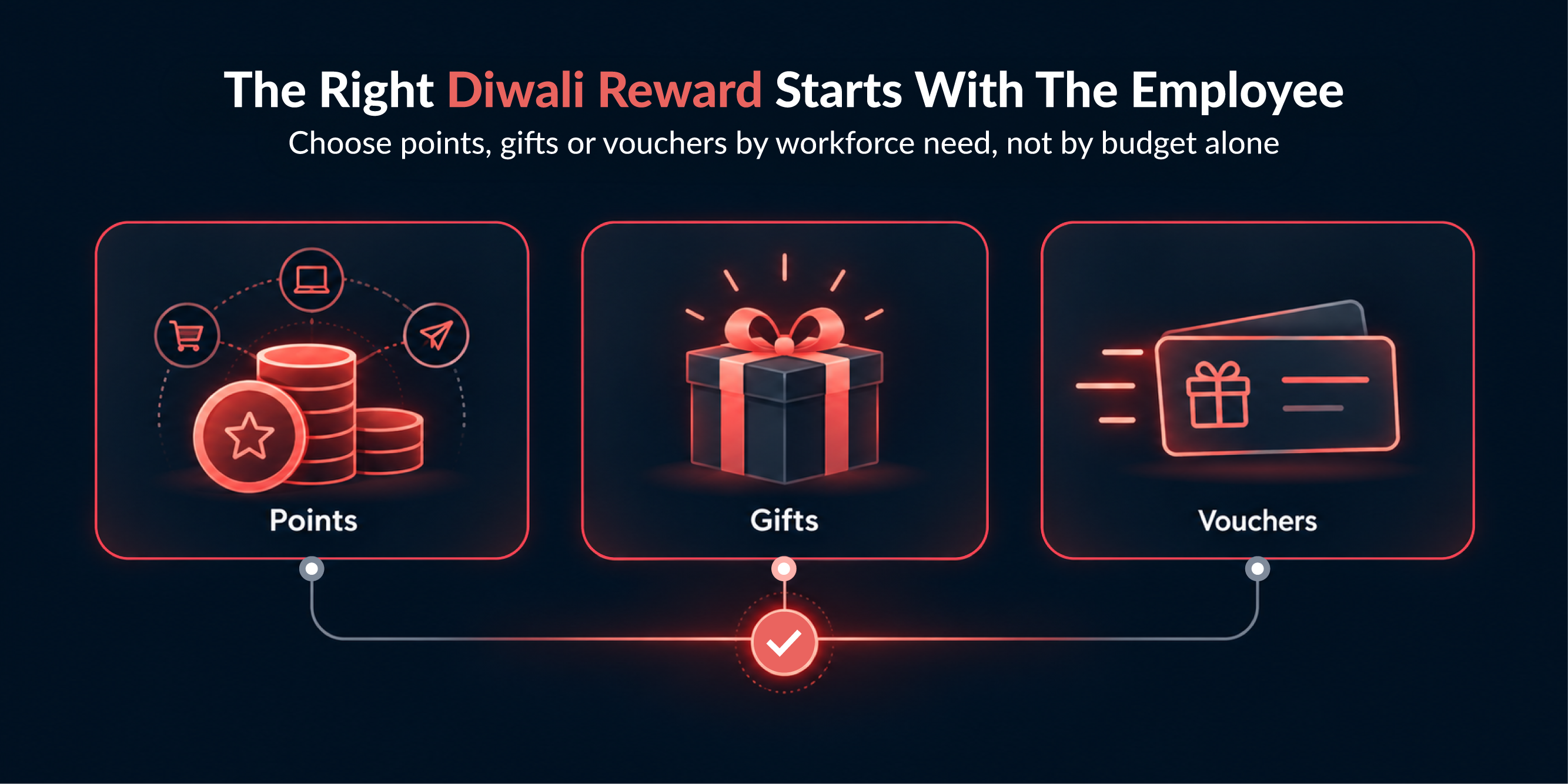
The best Diwali employee rewards ideas start with the employee group and not with the budget line. Points suit employees who value choice and can redeem digitally, physical gifts suit employees for whom a handed over object carries the meaning, and vouchers suit employees who need immediate value without a delivery chain. Most organisations with more than one kind of workforce should assign a format to each group, because identical spend lands differently depending on how the employee receives it.
What Points, Gifts and Vouchers Each Signal at Diwali
Each format signals a different message: points say that the employer trusts the employee to choose, gifts say that someone considered the employee personally, and vouchers say that the employer has provided value of a stated size.
A points based reward is a stored value that an employee earns and later exchanges for items of the employee’s choosing. A physical gift is a tangible item that the organisation selects and delivers. A gift voucher is a prepaid instrument that carries a fixed value and is redeemed with a defined set of retailers.
Why the signal outweighs the value
Employees read a format as evidence of the effort and trust behind the decision, so a voucher and a gift of equal value draw different reactions.
Two signal problems are specific to Diwali. Not every employee celebrates the festival, so a reward built around religious content can read as exclusion. A bonus under the Payment of Bonus Act, 1965 is a statutory entitlement for eligible employees, whereas a Diwali reward is discretionary, so presenting them together invites employees to judge the reward as an inadequate bonus.
How Points Based Rewards Work for Employees
Points work by separating the moment of recognition from the moment of choice, which gives the employee control but adds a step that the employee must complete. HR or a manager credits points to an account, and the employee redeems them against a catalogue at a time of the employee’s choosing. The reward system may be an employee recognition platform, an HRMS module or a managed spreadsheet, and that choice decides how much reconciliation Finance inherits.
The failure mode: the unspent balance
The common failure is credit without notice. An employee who does not know that points have arrived, or who receives them in the last days before Diwali, may not redeem them in time, and an unspent balance reads as an administrative entry and not as a gift. The control is to credit before festive shopping begins, notify at the moment of credit, and write expiry rules before launch, since expiry introduced later reads as withdrawal.
The counter argument
A balance on a screen lacks the ceremony of a wrapped gift in the hand, and that objection is correct for groups whose Diwali depends on presence. It is weaker for employees who already shop online and prefer to choose.
Where Physical Gifts Still Win
Physical gifts win where ceremony, shared presence or limited digital access matter more than individual choice. A gift handed over by a manager at a plant or warehouse gathering creates a shared moment that a credit to an account cannot reproduce, and a gift that enters the home is seen by the family at a festival celebrated at home.
Failure modes to control
Delivery comes first. Procurement, packing and courier transit all lengthen in the festive season, so distant gifts can arrive after the festival; the control is an order cut off date set by working backward from the date the gift must be in hand. Address accuracy comes second. Home addresses are personal data, so under the Digital Personal Data Protection Act, 2023 the organisation should confirm that the vendor handles them under defined terms, using HRMS addresses verified before ordering. Suitability comes third, since sweets and dry fruit may not suit employees with dietary restrictions.
When gifts are the wrong choice
Gifts are the wrong choice for groups spread across many cities with uneven delivery times, and for remote employees whose addresses are unverified. Use points or vouchers for those groups, since both reach the employee on the day of credit.
Comparing the Three Formats on Choice, Speed and Administration
The formats trade against each other: the format with the most choice is not the one that feels most personal, and the fastest is not the lightest to reconcile. The table compares the five criteria that HR teams most often weigh.
Reading the table
Speed and administration do not move together. A voucher is quick to issue but creates reconciliation work when employees use part of the value or let it expire, while a gift is slow to deliver but leaves no balance to track. Cash is generally taxed as salary, and the treatment of gifts and vouchers depends on form and value, so Payroll and Finance should confirm it first.
Combining Formats for a Distributed Workforce
A distributed workforce usually needs a combination, because no single format suits every site type, level of digital access and local cost. The aim is to match each group’s way of working and not to multiply options.
A worked scenario
Consider a manufacturing and services group with a head office, two plants, a field sales team across several states and a group of remote engineers. The HR Director divides the workforce by how people work and not by grade. Plant employees receive a physical gift from their managers at a shift gathering, which preserves the ceremony.
Head office employees and remote engineers receive points, because they have reliable digital access and prefer to choose. Field sales employees, who are rarely at one address, receive vouchers by message, since a parcel would often miss them. The Employee Engagement Lead writes one communication explaining the principle. The cost is that HR now manages three budgets and three sets of cut off dates instead of one.
Keeping value equivalent across locations
An equal rupee value does not give equal worth, because the same amount buys different things in a metropolitan city and a smaller town. A cost of living adjustment is a rule that scales a base reward value by location so that employees in different places receive equivalent purchasing power. Some employee recognition platform software applies this adjustment directly, and one example illustrates the mechanism.
ApplaudIQ is an employee recognition and rewards platform from The Reward Store. It applies a cost of living index to rewards and benefits, so HR sets a base value once and each location receives an equivalent value.
When a combination is the wrong choice
A combination is the wrong choice for a small organisation in a single location, or for an HR team without capacity to run several streams. Choose one format instead, usually a physical gift handed over in person, because the reconciliation cost of several streams exceeds the benefit of fit. A fair counter argument is that mixed formats invite comparison and a sense of unequal treatment, and the control is to keep value equivalent across groups and to state the principle openly.
A Diwali Reward Format Decision Guide
Match the format to each employee group by answering six questions in order.
- Divide employees into groups by how they work and receive communication, such as office, plant, field and remote, and not by grade.
- For each group, confirm whether members have reliable digital access and a verified delivery address in the HRMS record.
- Decide whether the group needs ceremony, choice or speed most, and choose the format that supplies it.
- Work backward from Diwali to the latest order or credit date, and set a cut off for each format.
- Ask Payroll and Finance to confirm tax treatment and budget ownership for each group, and confirm whether the organisation’s employee recognition platform, if it has one, can issue each format.
- After Diwali, review unspent balances, undelivered parcels and employee comments, and record the findings for next year.
Where ApplaudIQ Fits
An employee recognition platform fits where Diwali points belong to a recognition programme that runs through the year. ApplaudIQ supports peer to peer recognition, manager awards, award programmes and milestone moments on a company wide activity wall. Recognition and points can be sent from Slack, Microsoft Teams and Google Chat.
Employees redeem points for rewards of their choice, and HR can write custom emails. HR allocates budgets by team, country or programme, and managers recognise within limits that HR and Finance set. Employee data syncs in real time with the HRMS, and SAML single sign on gives one login across every country. Leavers move to a personal email address so that earned points stay accessible. It does not issue gift cards to retailers or brands.
Frequently Asked Questions
How do points based rewards work in ApplaudIQ?
In ApplaudIQ, recognition and points can be sent from inside Slack, Microsoft Teams and Google Chat, and both appear on the company wide activity wall. Employees redeem points for rewards of their choice. A reminder notification is sent when points are sent, and HR can write custom emails. Budgets are allocated by team, country or programme, managers recognise within limits that HR and Finance set, and spend is tracked as it is given.
Is it better to give employees Diwali vouchers or physical gifts?
Neither format is better in general. Vouchers suit employees who need value quickly with little administration and who shop at the retailers covered. Physical gifts suit employees for whom a handed over object carries meaning, particularly at sites where digital access is limited. Choose by employee group, delivery lead time and administration capacity, and ask Payroll and Finance to confirm the tax treatment before the format is fixed.
How early should we order Diwali gifts for employees in different cities?
Work backward from the date on which gifts must be in employees’ hands. Add time for procurement, packing, courier transit to the farthest location and one round of address verification, then add a margin for the festive peak, when couriers are busiest. Order for remote locations first. Where the lead time cannot be met, move that group to points or vouchers.
Are Diwali gifts to employees taxable in India?
The treatment depends on the form and value of the reward. Cash is generally taxed as salary, while gifts in kind and vouchers can be treated as perquisites above a limit set under income tax rules. Because limits and procedures change, Payroll should confirm the current position with the organisation’s tax adviser before the format is fixed. This answer is general information and not tax advice.
What is the difference between a Diwali bonus and a Diwali reward?
A Diwali bonus under the Payment of Bonus Act, 1965 is a statutory entitlement for eligible employees, and the Act sets out who qualifies. A Diwali reward is a discretionary gesture of recognition or goodwill given as points, gifts or vouchers. Communicate the two separately so that employees do not measure the discretionary reward against the statutory payment.
How do you keep Diwali rewards fair for employees who do not celebrate Diwali?
Offer a format that does not depend on the festival’s religious content, such as points that employees redeem for items of their own choice through an employee recognition platform, and describe the reward as seasonal appreciation. Avoid gifts built around religious items. Apply the same eligibility rule to every group, and give employees who observe other festivals a comparable recognition moment at their own time of year.
Sign up for our newsletter for trending top content!


