
Diwali Redemption for Credit Card Programmes: How Banks Can Offer a Better Festive Catalogue

Sign up for our newsletter for trending top content!
A bank can improve credit card reward redemption at Diwali by keeping its points programme under its own control and connecting it to a specialist redemption layer that supplies gift cards, travel, recharges and gift boxes under the bank’s own brand. The bank stays the issuer that earns, records and funds the points, while the partner acts as the burn layer that turns a points balance into a delivered reward. The work for a cards team is to choose the categories, define how each is fulfilled and decide who answers when a delivery fails.
Why Festive Redemption Exposes a Thin Catalogue
A thin catalogue becomes visible at Diwali because cardholders stop redeeming for themselves and start redeeming for other people, which multiplies the brands, denominations and delivery dates the catalogue must cover.
Demand changes in kind, not only in volume
In an ordinary month, redemption follows habit: a statement credit, a familiar voucher or a flight booking. In the weeks before Diwali, a cardholder is choosing gifts for relatives, colleagues, household staff and business contacts. The recipient decides what is useful, so the cardholder needs breadth of brand, a denomination close to the intended gift value and confidence that the item will arrive before the festival. A catalogue designed around the cardholder’s own spending patterns cannot meet that need, however large it is.
Where thinness shows first
The first signs are rarely a missing category. They are a preferred brand with no stock, a denomination step that strands a balance between two values, a page that slows under festive traffic and a delivery status that says nothing. Each one pushes the cardholder to pay for the gift with the card instead, which leaves the points unspent. Unspent points remain on the books as points liability, which is an accounting provision that records the estimated cost of points issued but not yet redeemed.
A useful diagnostic question for the cards team is this: of the ten brands cardholders asked the contact centre about last festive season, which could be redeemed in the exact denomination requested? Search logs and abandoned baskets answer the same question without a survey.
The Bank as Issuer and the Redemption Partner as Burn Layer
The bank should remain the issuer of points and the redemption partner should act as the burn layer, because the two roles carry different obligations and fail in different ways.
An issuer is the organisation that creates points, sets the earning rules, keeps the ledger and bears the cost of the reward. A burn layer is the system that converts a points balance into a delivered reward by sourcing the item, fulfilling it and reporting its status. A reward redemption engine is a system that performs that burn function by managing the catalogue, the fulfilment and the status tracking on the issuer’s behalf. The boundary between the two roles is a single instruction: debit this balance by this value and deliver this item.
The control that protects the ledger
The common failure sits at that boundary. If the ledger is debited and the delivery then fails, the cardholder has lost points without receiving a reward. If delivery succeeds and the debit fails, the bank has paid for a reward it never charged to a balance. Two controls catch both problems. The first is to treat the debit as final only after the burn layer confirms the order, and to reverse it automatically when the order fails. The second is a daily reconciliation of the bank’s debits against the partner’s order records, matched on a unique order identifier. Neither can be added reliably after launch, so both belong in the integration design.
The bank remains responsible, as card issuer, for compliance with Reserve Bank of India rules on credit card operations, whichever party delivers the reward. Personal data shared with the partner falls under the Digital Personal Data Protection Act, 2023, so the data passed across should be limited to what fulfilment needs.
Build or partner: the honest trade off
The case for building in house is real. A bank that owns the whole chain controls its margin, its journey and its data, and it carries no dependency on another party. The case for a partner rests on the number of supplier agreements behind a broad catalogue and on the engineering time needed before a festive peak.
Where cardholders redeem almost entirely as statement credit and rarely ask for gifts, a partner layer is the wrong investment. The better course is to improve the statement credit path and widen the catalogue later, when redemption history shows demand for it.
What a Festive Redemption Catalogue Should Include
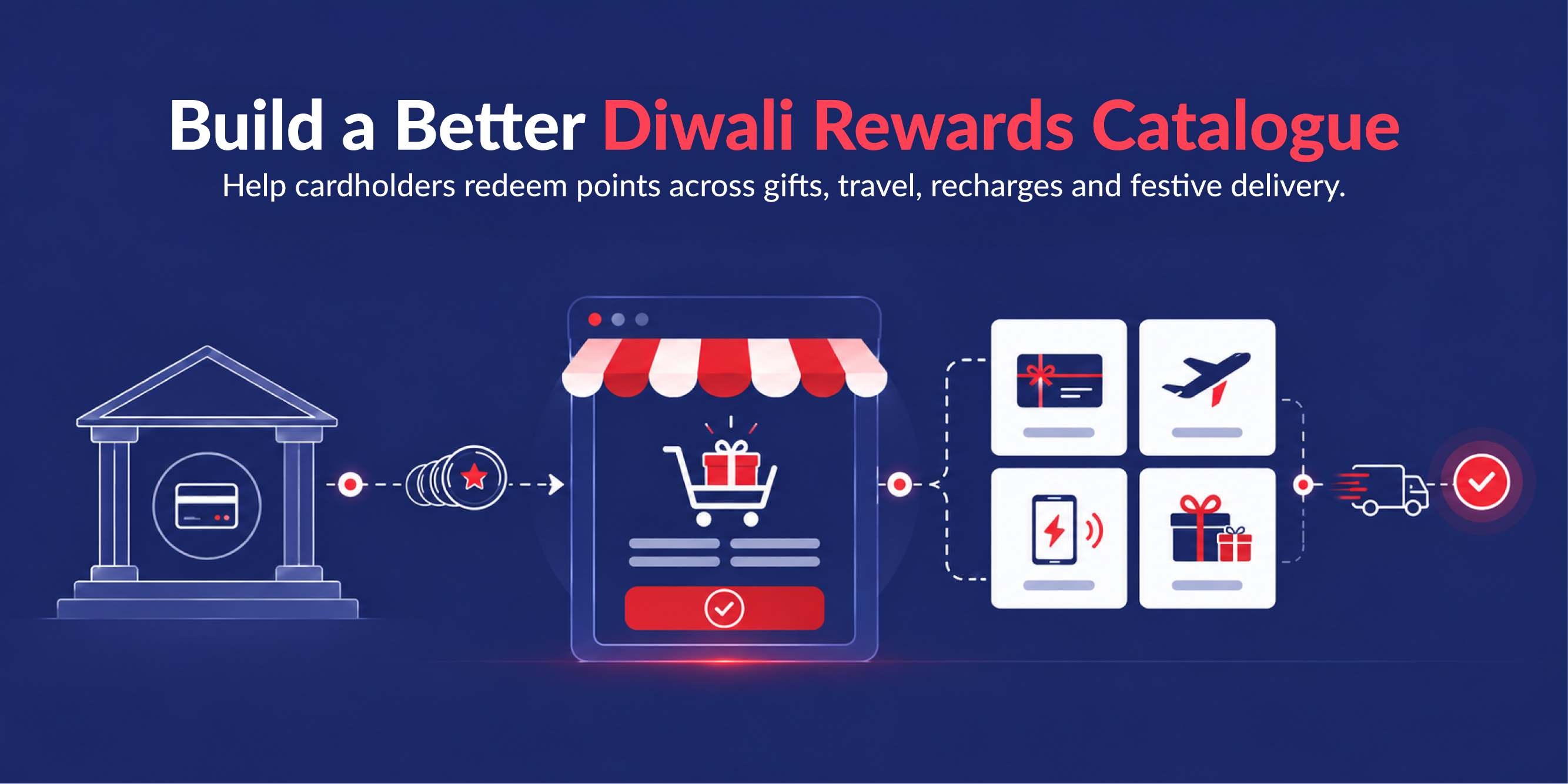
A festive catalogue should cover four categories, namely gift cards, travel, recharges and gift boxes, because each serves a different festive intent and each fails in a different way.
Gift cards
A voucher is a digital code or link that a recipient exchanges for goods or services at a named merchant. Brand mix matters more than volume, because the cardholder is choosing for the recipient. Check each merchant’s validity period and terms, since a voucher that expires soon after Diwali is a poor gift.
Travel
Festive travel is booked early, so flights and hotels are often redeemed before the gifting rush begins. The failure to watch is a price that changes between the search result and the confirmed booking. Define in advance how a cancellation reverses the points.
Recharges and utility payments
These redemptions are small and frequent, and they let cardholders use balances too low for a gift. A recharge to a wrong number cannot be recalled, so a confirmation screen before the debit is the only reliable control.
Gift boxes and experiences
Physical items depend on courier schedules. Display the last order date for Diwali delivery beside every item. When a reward redemption engine supplies the catalogue, ask which items it fulfils directly and which it routes to other suppliers, because that answer decides who is accountable when an item fails.
Keeping the Bank’s Brand Through a White Label Storefront
A bank keeps its brand by running redemption through a white label storefront, which is a shop front built and operated by a partner but presented entirely under the bank’s own name, domain, colours and logo.
Branding is more than appearance. Check four places where it commonly leaks: the web address, the sender name and footer on voucher emails and SMS messages, the support contact printed on the voucher, and the name shown in the cardholder’s order history. A cardholder who meets an unfamiliar domain during redemption is right to hesitate, since unfamiliar addresses are how phishing messages work. The domain is therefore a trust control as well as a design choice.
Curation is the second half of the brand. RedeemStack is a white label reward redemption engine and storefront from The Reward Store. It allows a programme to use its own domain, colours, logo and curated catalogue selection, which illustrates the point: the bank decides which brands and categories appear, and it can omit items that do not suit its customers or its risk policy.
The failure mode is the handover. If the cardholder must sign in a second time, or lands on a page with a different look, the experience suggests a separate company, and the cardholder may abandon the redemption. Test the full journey from the card app to the delivered voucher on a phone before the festive period.
Delivery and Support During Diwali Week
Delivery during Diwali week succeeds when every failed delivery has a defined second route and when the support team can see the same status the cardholder sees.
Why deliveries fail
Digital delivery fails for ordinary reasons: a mistyped email address, a full mailbox, an SMS blocked by a filter or a cardholder who has not opened the app. Delivery by email, SMS and in app, with automatic retry on failure, addresses these as a set. Physical gifts fail through address errors and courier cut offs, which is why the last order date must be visible.
What support needs
Most festive contact centre calls ask whether something was sent. A reward redemption engine that exposes real time delivery status through webhooks or reporting allows an agent to answer without escalation. Agree the escalation route before the peak, including who may reissue a voucher and how the points debit is treated when they do. Afterwards, Indian redemption transactions need invoices that meet GST rules, and a transaction level audit trail supports the daily reconciliation described earlier.
A worked scenario
Consider a hypothetical mid sized non banking finance company that issues a co branded credit card. In the previous festive season its portal listed a short set of vouchers, and several popular brands ran out of low denominations in the week before Diwali. Contact centre volume rose because cardholders could not tell whether an email voucher had been sent. For the next season the cards team acts in sequence.
It lists the brands cardholders asked about, asks its partner which of them can be fulfilled in the requested denominations, and agrees that delivery status will appear to the contact centre agent beside the points debit. The result is not a larger catalogue. It is a catalogue whose gaps are known before the festival and a support team that can answer the first question every cardholder asks.
A Festive Catalogue Review Checklist
A festive catalogue review is complete when each of the following ten questions has a named owner, such as the Head of Cards, the partnerships lead, the contact centre manager or the finance controller, and a recorded answer.
- Which brands did cardholders ask about last festive season, and which of them can be redeemed today?
- For each gift card brand, do the available denominations suit the balances cardholders commonly hold?
- Which items does the partner fulfil directly, and which are routed to other suppliers?
- Has the last order date for Diwali delivery been set and displayed beside every physical item?
- Has the full journey from the card app to a delivered voucher been tested on a phone?
- Do the domain, sender name, voucher footer and support contact all carry the bank’s identity?
- Is the points debit final only on order confirmation, and does it reverse automatically on failure?
- Is a daily reconciliation of debits against partner order records scheduled, using a unique order identifier?
- Has the escalation route been agreed, including who may reissue a voucher and how the debit is treated?
- Has finance confirmed GST invoice handling and the accounting treatment of unredeemed points?
Where RedeemStack Fits
A reward redemption engine sits between a bank’s points ledger and the cardholder’s delivered reward. RedeemStack is a reward redemption engine for programmes that already issue points or hold a budget balance. It converts an existing points or budget balance into a delivered reward. Its catalogue holds 5,000+ gift cards across 100+ countries, alongside prepaid cards, mobile recharges and utility payments, flights and hotels, gift boxes and experiences.
The storefront is fully white label, with the programme’s own domain, colours, logo and curated catalogue selection. A RESTful API with JSON responses and OAuth 2.0 authentication, with webhooks for delivery status, redemption events and catalogue updates, connects it to the issuer’s systems. It does not issue points, currency or gift cards, does not run earning logic or tiers and does not fund the rewards.
Frequently Asked Questions
How should a bank prepare its credit card reward catalogue for Diwali?
Start with the brands cardholders asked about last festive season and check which can be redeemed in the denominations they wanted. Then confirm stock cut off dates for physical gifts, test the storefront under festive traffic, and agree who answers delivery queries. Finish by reconciling debits against orders daily, so that any mismatch is found while cardholders can still redeem before the festival.
Which reward categories should a credit card programme offer for Diwali gifting?
A festive programme should cover gift cards for gifting, flights and hotels for festive travel, mobile recharges and utility payments for low value redemptions, and gift boxes or experiences for physical presents. Each category serves a different intent, so the bank should choose the mix from its own redemption history and complaint logs instead of copying another issuer’s list.
Can a bank use a third party for reward redemption and still keep its own brand?
A bank can do this. A white label storefront runs under the bank’s own domain, colours and logo, so the cardholder sees the bank’s brand throughout. The third party supplies the catalogue and fulfilment behind it. The bank should still check that the domain, the sender name on voucher emails and the support contact all carry its identity, because a single unbranded message breaks the impression.
What is the difference between a points issuer and a redemption partner?
A points issuer is the organisation that creates points, sets the earning rules, keeps the ledger and funds the reward. A redemption partner is the burn layer that converts a points balance into a delivered reward by sourcing, fulfilling and tracking the item. The partner does not issue points or fund rewards, and the issuer does not need to hold supplier agreements.
How do I stop customers losing points when a voucher fails to deliver?
Debit the points only when the redemption partner confirms the order, and reverse the debit automatically if the order fails. Show the cardholder a clear delivery status, retry failed deliveries on a second channel, and give the contact centre the same status view. Reconcile debits against partner order records daily, matched on a unique order identifier, so that mismatches are corrected before they become complaints.
When is it better to keep statement credit as the main redemption option instead of a festive catalogue?
Statement credit is the better main option when cardholders rarely ask for gifts, when engineering capacity is committed to core card systems, or when the programme is too small to justify supplier coordination. In those cases, improve the statement credit path first and widen the catalogue only when redemption history and complaint logs show sustained gifting demand.
How does RedeemStack connect to a bank’s existing rewards programme?
RedeemStack, from The Reward Store, connects to a bank’s programme through a RESTful API with JSON responses and OAuth 2.0 authentication, supported by documentation, SDKs and a sandbox. The bank remains the issuer and holds the points balance. It converts that balance into a delivered reward, and webhooks report delivery status, redemption events and catalogue updates to the bank’s systems.
Sign up for our newsletter for trending top content!


