
What Are the Best Practices for Building a Corporate Gift Catalogue Employees Actually Value?

Sign up for our newsletter for trending top content!
Introduction
Gallup reports that workplace recognition increases employee engagement, productivity, loyalty and retention, yet many gifting programmes still fail because the catalogue feels generic, hard to use or poorly matched to employee preferences. A corporate gift catalogue should not function as a static list of items. It should help HR leaders offer relevant, timely and well governed appreciation across different employee groups, locations and occasions.
For HR leaders, the catalogue design directly affects employee experience, procurement control and recognition quality. This article explains what a corporate gift catalogue should include, when to use an open or closed catalogue, how to govern budgets and suppliers, and how The Reward Store supports physical gifting and storefront led reward access for enterprise teams.
Why Does a Corporate Gift Catalogue Matter for Employee Recognition?
A corporate gift catalogue matters because reward choice affects whether employees experience recognition as useful, personal and fair. Gallup states that recognition helps employees feel valued and supports engagement, productivity, loyalty and retention. This means the catalogue must support the recognition message, not weaken it through irrelevant or low value choices.
A poorly designed catalogue creates three problems. First, employees may not find anything they want. Second, HR may struggle to control spend across departments and locations. Third, procurement teams may face inconsistent supplier quality, delivery gaps and weak reporting.
A strong catalogue gives HR a controlled way to offer choice. It can include physical gifts for milestone moments, digital rewards for instant recognition and premium categories for leadership or long service appreciation.
O.C. Tanner reports that employees who feel appreciated are five times more likely to stay, which reinforces the need for appreciation that feels meaningful rather than administrative.
What Should a Corporate Gift Catalogue Include?
A corporate gift catalogue should include a balanced mix of practical, aspirational, physical and experiential reward categories. HR leaders should avoid building a catalogue around personal assumptions. Employees across age groups, locations, roles and income levels value different reward types.
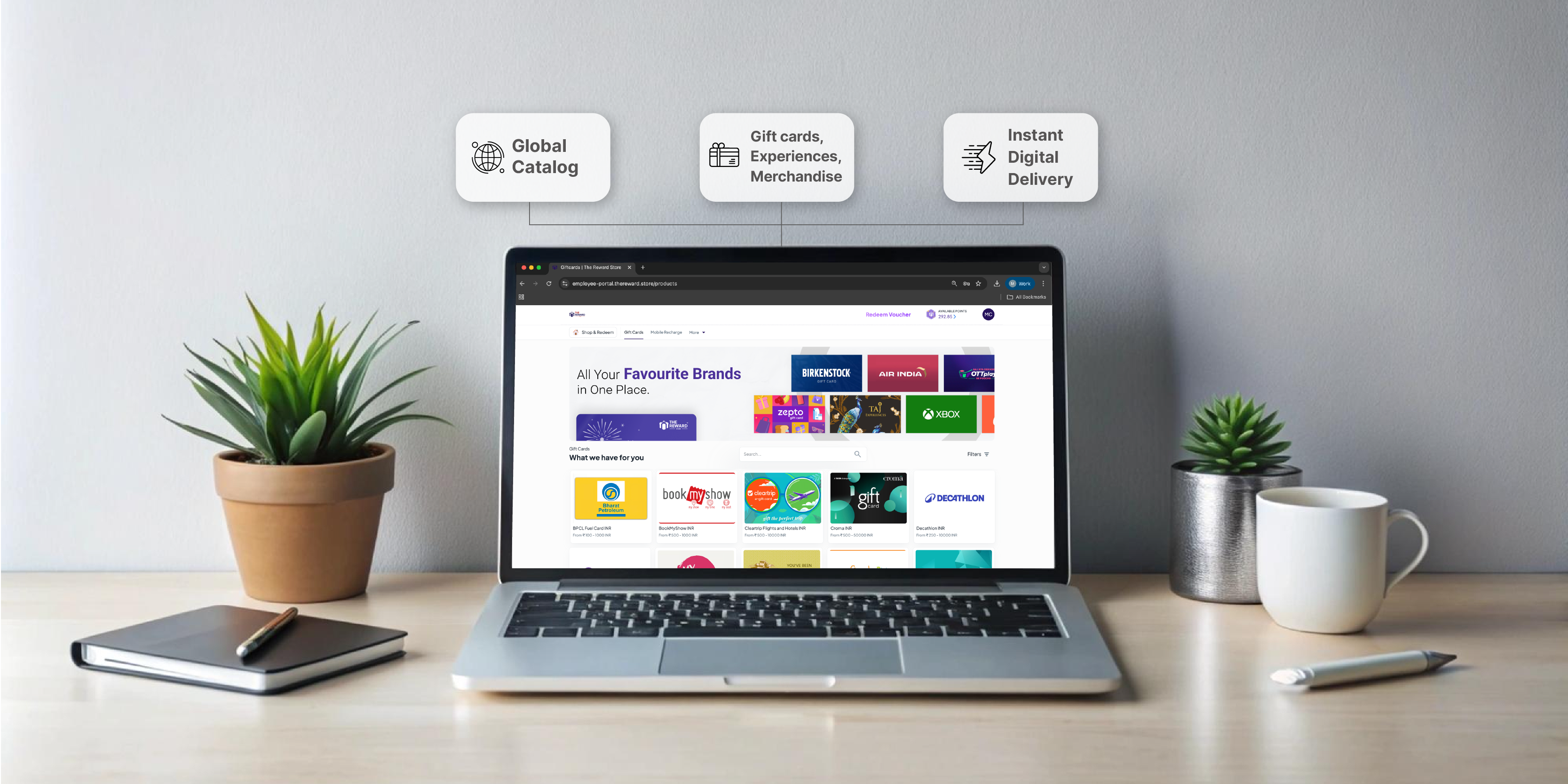
The Reward Store’s integrated storefront supports gift cards from 5,000+ brands, flight bookings, hotel bookings, dining, golf, sports, experiences, merchandise, bus bookings and concierge services. For enterprise gifting, HR can also use curated physical gifts for onboarding, festivals, service anniversaries, leadership appreciation and milestone recognition.
Recommended Catalogue Categories
SHRM notes that employee recognition must be done well to support engagement and culture, which means catalogue relevance matters as much as catalogue size.
The best catalogue feels broad without becoming confusing. HR should use clear categories, budget filters, occasion based collections and employee friendly descriptions.
Should HR Choose an Open or Closed Corporate Gift Catalogue?
HR should choose an open or closed corporate gift catalogue based on budget control, employee choice and recognition purpose. An open catalogue gives employees wider freedom to select rewards. A closed catalogue gives HR tighter control over what employees can access.
Open vs Closed Corporate Gift Catalogue
An open catalogue works well when HR uses points based recognition, peer recognition or performance awards. Employees can choose what matters to them, which improves perceived value.
A closed catalogue works well when the occasion requires consistency. For example, HR may want every employee to receive a curated festive collection or onboarding kit that reflects the employer brand.
A hybrid catalogue often works best at scale. HR can offer a curated physical gift for the moment and add access to selected storefront categories for personal choice. This approach protects ceremony while improving relevance.
Deloitte’s procurement practice highlights the importance of sourcing strategy, operating model design and procurement transformation when organisations need measurable and sustainable outcomes. That principle applies to catalogue governance, especially when HR manages gifting across locations or employee segments.
How Should HR Segment a Corporate Gift Catalogue?
HR should segment a corporate gift catalogue by occasion, employee group, budget band, geography and fulfilment need. A single catalogue for every use case often becomes too broad for employees and too difficult for HR to govern.
Segmentation allows HR to make the catalogue feel more relevant while keeping procurement and finance controls intact.
Catalogue Segmentation Framework
Gallup states that recognition should feel authentic, honest and individualised. Segmentation helps HR deliver that principle at scale because it prevents every employee from receiving the same generic experience.
For example, a remote employee may value direct to home fulfilment and digital choice. A new joiner may value a curated physical onboarding kit. A long service award recipient may value travel, dining or premium experiences.
HR should review catalogue usage every quarter. Low selection or redemption in a category may reveal poor relevance, weak communication or limited availability.
What Governance Rules Should a Corporate Gift Catalogue Follow?
A corporate gift catalogue needs clear governance so HR can scale gifting without budget leakage, supplier inconsistency or employee confusion. Governance should define who can issue rewards, which budgets apply, which employees qualify, what tax reporting is required and how fulfilment exceptions will be handled.
Deloitte’s procurement guidance stresses supplier strategy, operating model development and sourcing delivery for sustainable results. Enterprise gift catalogues need the same discipline because they combine employee experience with procurement execution.
Corporate Gift Catalogue Governance Checklist
Governance should not make the catalogue difficult to use. It should make gifting consistent, auditable and fair.
The Reward Store’s Physical Gifting Solutions help enterprises manage curated gifting, procurement and fulfilment. HR teams can also use TRS X Storefront API for storefront led reward access and ApplaudIQ Employee Recognition for recognition programmes connected to rewards.
How Can HR Measure Whether a Corporate Gift Catalogue Is Working?
HR should measure catalogue success through employee experience, cost efficiency, fulfilment reliability and recognition outcomes. Dispatch completion alone does not prove the catalogue is effective. A reward can arrive on time and still fail if employees do not value it.
SHRM states that recognition needs to be authentic, timely and frequent to support culture. Catalogue measurement should therefore include usage and sentiment, not only procurement data.
Corporate Gift Catalogue Measurement Dashboard
HR should also track catalogue performance by location, department, work mode and employee level. If one group consistently selects fewer rewards or reports lower satisfaction, the catalogue may not reflect their needs.
The best catalogue evolves. HR should retire low value items, expand high performing categories and refresh seasonal collections before employees lose interest.
What Mistakes Should HR Avoid When Building a Corporate Gift Catalogue?
HR leaders should avoid treating a catalogue as a procurement list. A corporate gift catalogue should function as an employee experience tool with procurement discipline behind it.
Common Catalogue Mistakes
Mistake 1: Offering too few choices.
Employees may not find rewards that match their preferences.
Mistake 2: Offering too many unstructured choices.
A large catalogue without filters can create decision fatigue.
Mistake 3: Ignoring fulfilment complexity.
Physical gifts need packaging, delivery tracking, replacement rules and supplier accountability.
Mistake 4: Not aligning with finance and tax teams.
Reward value, eligibility and reporting rules should be clear before launch.
Mistake 5: Using the same catalogue for every occasion.
An onboarding gift, festive gift and performance award need different curation.
Mistake 6: Not measuring employee feedback.
Catalogue usage data alone does not explain whether rewards felt meaningful.
O.C. Tanner’s culture research links appreciation with retention, which makes these mistakes commercially important. When a gift catalogue feels careless, it can weaken the recognition moment rather than support it.
Frequently Asked Questions
What should a corporate gift catalogue include?
A corporate gift catalogue should include physical gifts, gift cards from 5,000+ brands, travel rewards, dining, sports, experiences, merchandise and premium services where relevant. The best mix depends on workforce profile, budget, occasion and fulfilment requirements.
How does an open corporate gift catalogue differ from a closed catalogue?
An open catalogue gives employees broader freedom to choose rewards. A closed catalogue limits choices to a curated set, which works well for controlled campaigns, festivals, onboarding and budget specific gifting.
Why should HR use a corporate gift catalogue instead of one standard gift?
A catalogue gives employees more relevant choice and gives HR better control over budgets, fulfilment and reporting. One standard gift may work for certain occasions, but it rarely fits a diverse workforce.
When should HR use physical gifts in a corporate catalogue?
HR should use physical gifts for moments that need emotional weight, such as onboarding, festive gifting, service anniversaries, premium recognition and leadership appreciation. The Reward Store’s Physical Gifting Solutions support curated procurement and fulfilment for these moments.
Can The Reward Store support both physical gifting and storefront rewards?
Yes. The Reward Store supports enterprise physical gifting and an integrated storefront that includes gift cards from 5,000+ brands, flights, hotels, dining, golf, sports, experiences, merchandise, bus bookings and concierge services.
How should HR measure corporate gift catalogue success?
HR should measure catalogue selection rate, redemption rate, delivery success, category preference, employee satisfaction, cost per reward and segment level feedback. These metrics show whether the catalogue delivers both operational efficiency and employee value.
Conclusion
A corporate gift catalogue works best when it combines employee choice with HR governance. The strongest catalogues include relevant categories, clear budget rules, reliable fulfilment, open and closed catalogue options, and regular performance measurement. Gallup, SHRM, Deloitte and O.C. Tanner all support the same principle: recognition has value when it feels meaningful, well timed and well executed.
As workforces become more distributed, HR leaders will need catalogues that offer both curated physical gifting and flexible storefront access. The organisations that design that balance now will improve recognition quality and employee experience at scale.
Ready to build a corporate gift catalogue that balances choice, quality and enterprise fulfilment?
Explore how The Reward Store helps HR teams curate physical gifts and create scalable reward experiences for employees across locations.
Explore Corporate Physical Gifting Solutions
Sign up for our newsletter for trending top content!


